Itinerary · Oceania · 5 days · Moderate
Funafuti Atoll, End to End
Vaiaku, Fongafale→Tengako, north Fongafale→Funafuti Conservation Area→Funafala→Fusi and the Philatelic Bureau, Vaiaku
Tuvalu has nine islands - six atolls and three reef islands - 26 square kilometres of land and one airstrip, served three times a week from Suva. The outer islands are reached only by a government ship that runs on its own calendar and takes days each way, so a short trip is Funafuti or nothing - five days on the one atoll, walked end to end and crossed twice by boat, with every night in Vaiaku.
Vaiaku
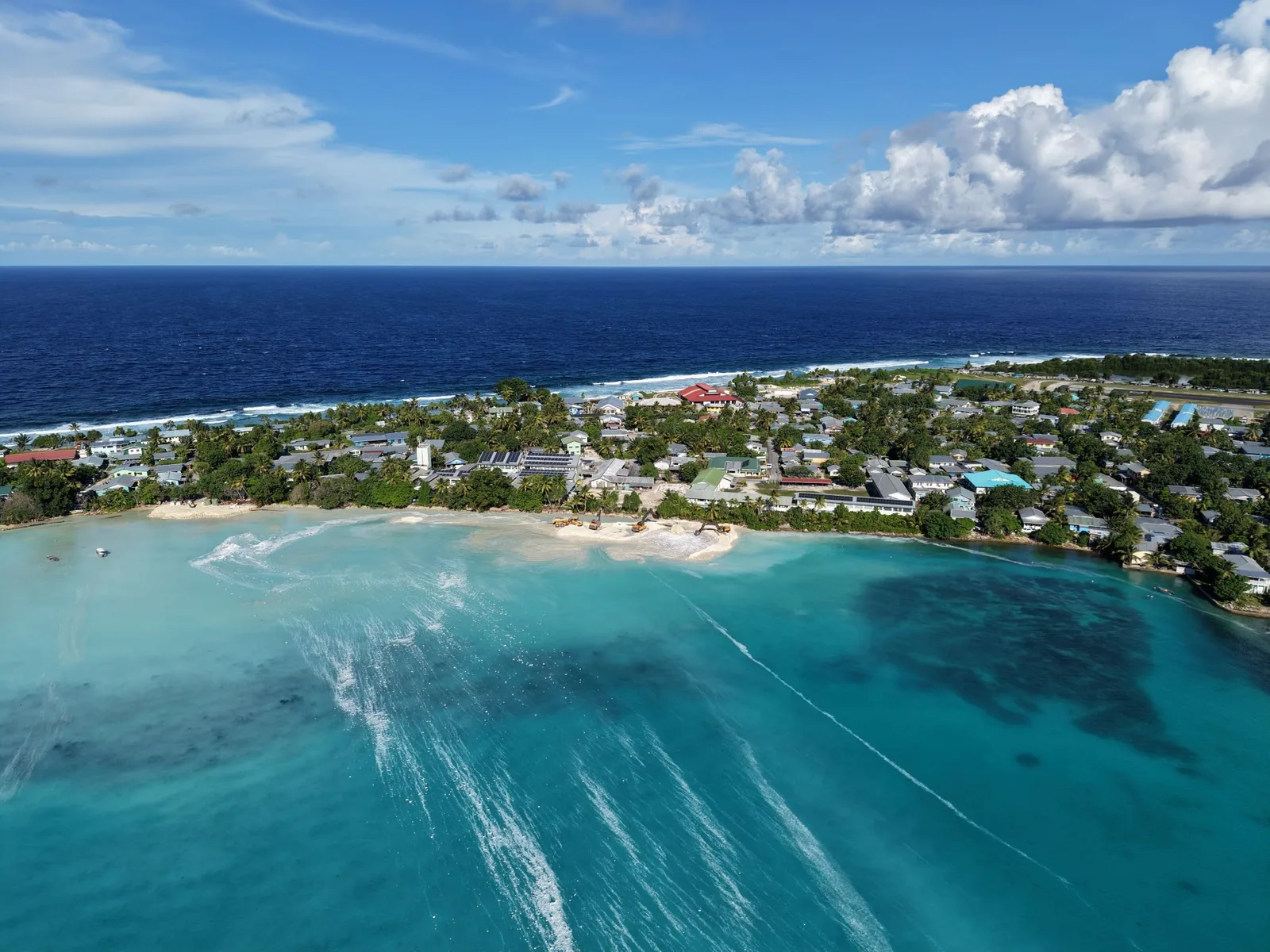
The aircraft lands on an airstrip that is also a football pitch, a volleyball court and, in the cool of the evening, the place most of the capital sits down. A siren clears it before each movement and the tarmac refills within minutes of the aircraft turning. Vaiaku itself is a few hundred metres of government offices, the hotel, the National Bank of Tuvalu and the wharf: ministries, bank and port within sight of each other, which is how business here gets done - in person, on foot, usually the same day. Alongside the lagoon shore is the newest ground in the country: 7.8 hectares dredged up and raised above the tide under the Tuvalu Coastal Adaptation Project, finished at the end of 2023 and now the flattest, driest and emptiest land on the atoll. Walk the wharf, where an Australian-funded tide gauge has been recording sea level since 1993, and then go and sit on the runway with everybody else.
The length of Fongafale
Fongafale is about twelve kilometres long and in places twenty metres wide, with one road down it and the ocean audible on both sides at once. Walking or riding it north is the best day on the atoll. The wide water-filled pits inland are not lagoons: American Seabees quarried the coral out of the middle of the islet in 1943 to build the airfield for the Gilbert Islands campaign, and the holes were still there, filling with rubbish and seawater, seventy years later - a New Zealand-funded remediation filled a number of them in 2015 and the rest are a lesson in what borrowed material costs. Further north is the site of David's Drill, where three Royal Society expeditions bored into the atoll between 1896 and 1898, reaching 340 metres on the last attempt and returning coral all the way down, which was the evidence Darwin's subsidence theory had been waiting on since 1842. The road ends at Tengako. Amatuku is the islet beyond it, and the Tuvalu Maritime Training Institute on it has been putting Tuvaluan men onto foreign merchant ships since the 1970s - seafarer wages sent home are, with fishing-licence revenue and the lease of the .tv domain, one of the few earnings this country generates for itself.
The Funafuti Conservation Area
The western rim of the atoll, forty-five minutes across the lagoon in an open boat: 33 square kilometres of reef, lagoon and six uninhabited islets, closed to fishing since 1996. Tepuka Vili Vili, Fualopa, Fuafatu, Vasafua, Fuagea and Tefala are what Fongafale looked like before the airfield - green turtles nest on them and Fualopa carries a black noddy colony. The reserve also records what weather does here: Vasafua lost its coconut palms outright to Cyclone Pam in 2015, and the islets have visibly changed shape within living memory. Arrange the boat through the Kaupule the day before, take your own water and shade, and accept that it does not run in wind.
Funafala
South down the eastern rim to the far end of the atoll, where a handful of families live on an islet with no road to it, no shop and no power grid beyond what solar panels provide. Funafala took in evacuees from Fongafale during the Second World War, when the Americans occupied the middle of the atoll, and people have kept houses and pigs and pandanus there ever since. It is the clearest possible picture of what the outer islands are like without spending a week on a ferry to reach one. Take food, ask before you photograph anybody or anything, and go back before dark.
The capital on foot, and out
The flight leaves in the early afternoon, which gives a morning. The fusi - the cooperative store - is where the country actually buys its food, and walking round it tells you more about the cost of living on an atoll than any figure will: almost everything on the shelves crossed an ocean to get there. The Philatelic Bureau still sells the stamps that were a genuine national revenue stream before the lease of the .tv domain overtook them. The National Library and Archives holds what documentary record the country has, which is part of what the government is now copying to servers offshore. Then back to the runway, where the siren goes, everybody stands up and walks off the tarmac, and the aircraft comes in.
Good to know
The whole trip is dictated by the flight. Fiji Airways operates Funafuti from Suva's Nausori airport - not Nadi - three times a week on a turboprop, so the gaps between departures are two or three days and the possible lengths of stay are fixed at two, three, four, five or seven nights; this route takes the four-night gap, which is five days on the ground. A cancellation is not an inconvenience, it is another two or three days in the country, so never plan a tight onward connection out of Suva and expect a strict baggage allowance on the way in. Book a bed before you book the flight and not the other way round: there are a few dozen tourist beds in the country, immigration asks for confirmed accommodation and an onward ticket, and the aircraft can and does fill with government and contractor traffic. Most nationalities are issued a visitor's permit of up to a month on arrival; those not on the exempt list buy a visa on arrival, currently A$100, and everyone needs six months on the passport. The currency is the Australian dollar - Tuvalu issues its own coins but every transaction of consequence is in AUD, and until 2025 there was no ATM anywhere in the country. The National Bank of Tuvalu has since installed a small number of machines and card terminals on Funafuti, which is genuinely new and not yet something to depend on; bring Australian cash and treat cards as a fallback. Sunday is observed seriously. The Ekalesia Kelisiano Tuvalu is the church most of the country belongs to, boats do not go out, shops do not open and the atoll is quiet from Saturday evening - dress modestly, and if you are invited to a service, go. Cyclone season runs November to April; the more reliable months are May to October. The flooding that matters here is not storm surge but the king tides of February and March, when water comes up through the coral floor of the islet in the middle of Fongafale rather than over the beach, which is why so much of the settled ground is now raised fill. Fresh water is rainwater catchment and there is no groundwater fit to drink - use it as if it were scarce, because it is. The outer islands are served by the government ships Nivaga III and Manu Folau, deck passage, a handful of sailings a month, three or four days each way and no schedule you can hold to from abroad: they are a serious undertaking and they are not compatible with a five-day trip. Land on the atoll is customary and every islet has owners, so ask before you land, walk across or photograph, and go through the Kaupule - the island council - for boats to the conservation area rather than freelancing at the wharf. Almost every item of food is imported and priced accordingly, phone coverage and internet are improving but thin, and there is no hospital care beyond the Princess Margaret at Vaiaku, so travel insurance with genuine evacuation cover is not optional.
Shorter or longer?
Add ten days to a fortnight and take Nivaga III or Manu Folau north to Vaitupu, Nukufetau or Nanumea. Deck passage, no cabins worth the name, three or four days at sea each way and a return sailing that may move by days. It is the only way to see the eight islands that are not Funafuti and it cannot be planned to a date.
Take the short gap between two flights instead of the long one. It buys Vaiaku, the length of Fongafale and the runway in the evening, and it drops both boat days - which means the conservation area, Funafala and any sight of the atoll from the water.
Practical guide
Visa check for this route
Budget
Mid-range · per person · sharing a double room. Excludes international flights - they depend on where you fly from.
Editorial estimates · checked August 2026
Country guides
Trip essentials
The connectivity placement is our own eSIM store. No affiliate link on this list. How we choose these →