 Aibek · Pexels License
Country Guide № 090 / 194 · Asia
Kyrgyzstan
Ninety per cent mountain, and yurts on most of it in summer.
“Ninety per cent mountain, and yurts on most of it in summer.”
Kyrgyzstan is the one Central Asian country built for independent travel. Ninety-four per cent of it is above a thousand metres, the summer jailoo pastures fill with herder families in yurts, and a genuinely functional community-based tourism network puts you in those yurts for €20 a night with dinner. Visa-free entry for sixty days removes the last obstacle.
The trekking is the reason to come - the Ala-Kul pass above Karakol, the walk to Song-Kul, the high valleys of the Tian Shan - and it is concentrated into a short season. Snow closes the passes until June and returns in September. Outside that window the country is still worth visiting for Issyk-Kul and the cities, but the thing it does better than anywhere nearby is only available for about three months a year.
Chapter 01
Highlights
Song-Kul
A high alpine lake at 3,016 metres surrounded by summer pastures and yurt camps, reached on horseback or by 4×4 over a pass. Two nights, and go before mid-September.
The Ala-Kul trek
Three days from Karakol over a 3,900-metre pass to a turquoise glacial lake and down to the Altyn Arashan hot springs. The best-known trek in the country and deservedly so.
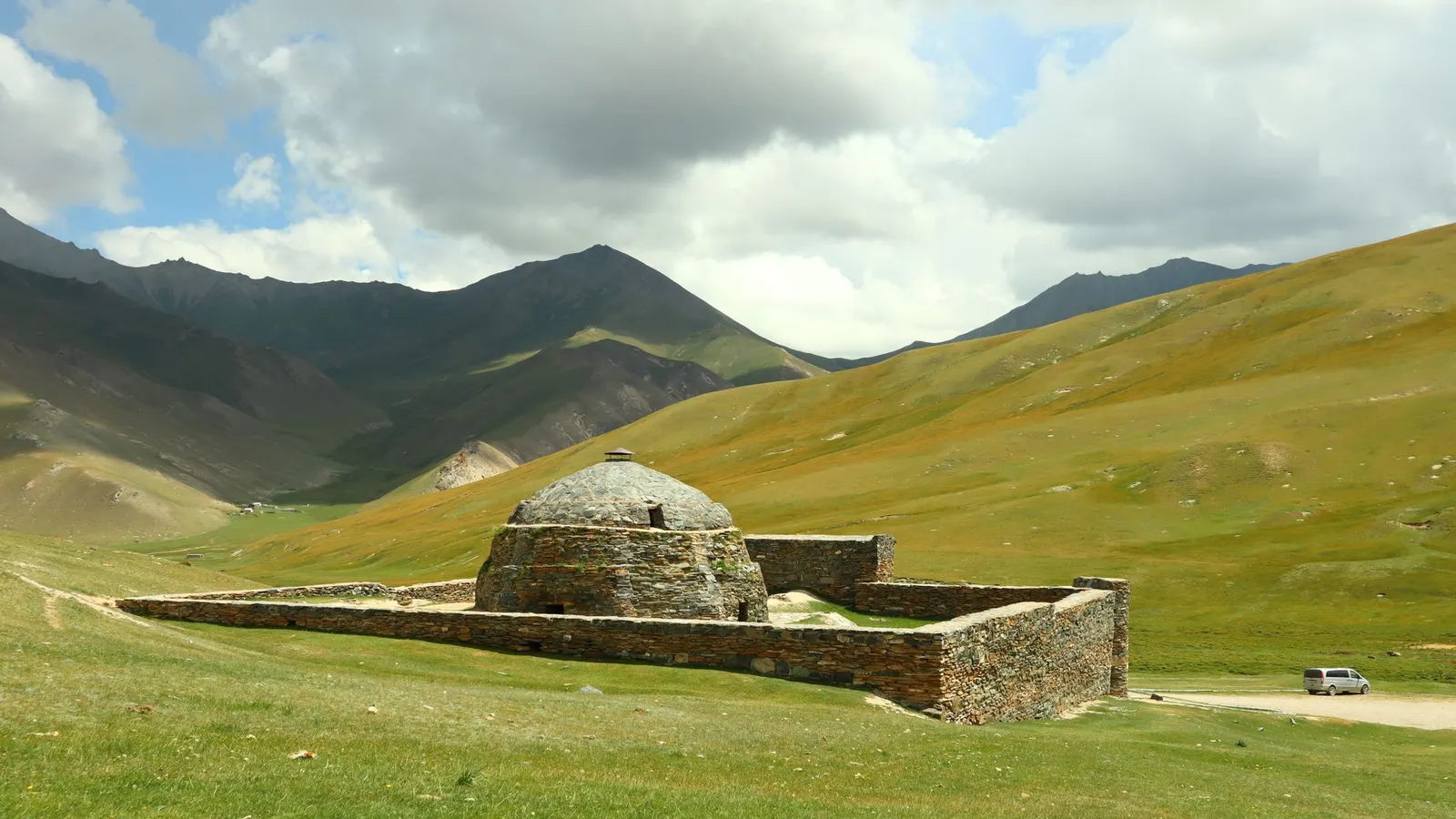
Tash Rabat
A fifteenth-century stone caravanserai in an empty valley near the Chinese border, with yurt stays alongside it. The most atmospheric Silk Road remnant in the country.
Issyk-Kul
The world's second-largest alpine lake, 180 km long and never freezing, with a Soviet-era resort coast on the north shore and canyons and petroglyphs on the south.
Chapter 02
Entry requirements for Kyrgyzstan
Checking your passport…
up to 60 days · free entry
60 days on arrival
Before you fly
The detail
- Maximum stay
- up to 60 days
- Fee
- free entry
- Passport validity
- Most destinations want validity beyond your stay, and some want six months. Check yours against the return date.
- Onward travel
- Airlines may ask for a return or onward ticket at check-in.
- Health
- No vaccinations required; hepatitis A and typhoid standard, rabies worth considering, tick-borne encephalitis for summer mountain travel. Altitude matters on every trek. Do not drink untreated water - filter or boil, including in the mountains where livestock graze upstream. Medical facilities are basic outside Bishkek; insurance covering trekking and helicopter evacuation is essential.
- Money
- Cash economy outside Bishkek. ATMs in Bishkek, Osh and Karakol accept foreign cards; village CBT coordinators and yurt camps take cash only, so carry som for the whole mountain leg. Cards work in Bishkek supermarkets and better restaurants. The som is stable. Tipping is not expected but rounding up is normal.
A United States passport enters Kyrgyzstan without a visa for 60 days, free, with no application and no registration unless the stay runs past those 60 days - one of the most open regimes anywhere and twice what the neighbours give. The passport should be valid six months. Central Asia is not one visa area. Kazakhstan, Kyrgyzstan, Uzbekistan, Tajikistan and Turkmenistan each answer for themselves, the answers differ by weeks of allowance and by whether anything has to be bought at all, and every border between them is an ordinary international crossing with its own queue, its own opening hours and its own list of who may use it. A joint regional visa on the Schengen model has been announced more than once; at the time of writing none can be bought, so plan each country's entry separately and check the specific crossing rather than the region. The paperwork that actually matters in Kyrgyzstan is not the visa, and it is the reason trekkers get turned round: BORDER-ZONE PERMITS. Large parts of the high country near the Chinese and Tajik frontiers are restricted areas, and that includes the places people come for - Kel-Suu, the Enilchek (Inylchek) glacier and Khan Tengri approaches, and stretches near the Tajik border on the way to the Pamirs. A permit is arranged through a local agency and needs a week or two of lead time; it cannot be bought at the checkpoint, talked past, or sorted out from the trailhead, and the soldiers at the barrier are not the people to negotiate with. Decide the itinerary before you arrive if any of it is near a border. The crossings themselves are worth reading in advance too: Torugart, the pass into China, is not an ordinary border post - transport must be arranged on both sides in advance and independent travellers cannot simply turn up, while Irkeshtam is the usual alternative. Going south to Tajikistan over the Pamir Highway means having the Tajik paperwork already: the e-visa with the GBAO endorsement, or the GBAO permit obtained in Dushanbe, because Sary-Tash is a long way from anywhere to discover a missing permit. Registration inside the 60 days is not required.
Check another destination with this passport →
Entry details: Editorial synthesis - Kyrgyz Ministry of Foreign Affairs visa-free list, State Border Service permit guidance (2025–2026) · compiled 18 Sept 2026
Who needs a visa for Kyrgyzstan
12 common passports| Passport | Requirement | Stay | Process |
|---|---|---|---|
| United States | Visa-free | up to 60 days | No process · €0 / $0 |
| United Kingdom | Visa-free | up to 60 days | No process · €0 / $0 |
| Germany | Visa-free | up to 60 days | No process · €0 / $0 |
| India | e-Visa | - | No Other passports record yet |
| China | e-Visa | - | No Other passports record yet |
| Brazil | Visa-free | up to 60 days | No Other passports record yet |
| Nigeria | e-Visa | - | No Other passports record yet |
| Indonesia | Visa on arrival | - | No Other passports record yet |
| Philippines | Visa on arrival | - | No Other passports record yet |
| Vietnam | Visa-free | up to 60 days | No Other passports record yet |
| Egypt | e-Visa | - | No Other passports record yet |
| Nepal | e-Visa | - | No Other passports record yet |
Holding a passport that is not listed? The picker above answers for any of them. See where your passport takes you. Source: Passport Index, updated 14 Aug 2026.
Chapter 03
When to go
BestJun–Sep. AvoidNov–Mar.
Trekking season opens as the snow clears; yurt camps go up.
The band above each month is our editorial verdict - it weighs crowds, prices and access as well as weather. The line is average daily temperature, the bars are monthly rainfall. Select a month for the figures. Climate figures: ERA5 reanalysis via Open-Meteo, 2005–2024 normals.
Chapter 04
What it costs
A day in Kyrgyzstan
Comfortable · sample day
≈ $43
Line items are real prices we track. The daily budget is an editorial estimate for this level, not their sum.
Where this sits among 244 countries we have costed
The mountain economy exists for about three months. Yurt camps open in June and fold in September, and their rates are effectively fixed by the community networks rather than by demand. Bishkek and Osh accommodation is flat year-round. The one real spike is around the World Nomad Games in the years it is hosted here.
Updated Aug 2026 · Editorial synthesis - CBT and community network published rates, operator quotations (2025–2026) · confidence high
Excludes international flights - they depend on where you fly from.
Chapter 05
Regions to know
5Bishkek & Chüy
The capital under the Ala-Too range, with the Ala Archa gorge forty minutes away and Burana tower on the Silk Road east.
Issyk-Kul
The great alpine lake - Karakol and the Ala-Kul trek in the east, canyons and petroglyphs on the southern shore.
Naryn & the central Tian Shan
Song-Kul's pastures, the Tash Rabat caravanserai and the remote lake of Kel-Suu near the Chinese border.
Osh & the Fergana valley
The southern capital with the sacred Sulaiman-Too mountain, a great bazaar, and a very different feel from the north.
The Pamir approach
Sary-Tash and the road toward Tajikistan, with the Pamir wall on the horizon - the start of the Pamir Highway.
Chapter 06
Practical guide
Getting there
Bishkek Manas (FRU) takes flights from Istanbul, Dubai, Moscow and increasingly from European cities via Turkish and flydubai; Osh (OSS) serves the south. Overland from Kazakhstan (Korday), Uzbekistan (Osh–Andijan) and Tajikistan (the Pamir Highway at Sary-Tash) is routine in season; the Torugart and Irkeshtam passes into China have restrictive rules and need advance arrangement.
Getting around
Marshrutkas and shared taxis link every town cheaply and depart when full. Hired 4×4s with drivers cover the mountain routes to Song-Kul and Tash Rabat at €80–110 a day. Bishkek has buses and Yandex Go. Domestic flights connect Bishkek and Osh in 45 minutes for around €35, which beats the twelve-hour road over the mountains. Hitching is common and safe by local custom, with a small payment expected.
Money & costs
Cash economy outside Bishkek. ATMs in Bishkek, Osh and Karakol accept foreign cards; village CBT coordinators and yurt camps take cash only, so carry som for the whole mountain leg. Cards work in Bishkek supermarkets and better restaurants. The som is stable. Tipping is not expected but rounding up is normal.
Safety
Low crime, with petty theft in Bishkek and Osh bazaars the main risk. The genuine hazards are mountain - weather, river crossings, altitude and shepherd dogs, which guard flocks and take their job seriously. Carry a stick and do not approach yurts without hailing first. Border areas with Tajikistan have seen periodic armed clashes and should be checked before travelling near them. Road accidents on mountain passes are the largest single risk.
Health
No vaccinations required; hepatitis A and typhoid standard, rabies worth considering, tick-borne encephalitis for summer mountain travel. Altitude matters on every trek. Do not drink untreated water - filter or boil, including in the mountains where livestock graze upstream. Medical facilities are basic outside Bishkek; insurance covering trekking and helicopter evacuation is essential.
SIM & internet
Beeline, O! and MegaCom SIMs cost a couple of euros with generous data. Coverage is surprisingly good in valleys and towns and absent on the passes. Wifi is standard in Bishkek and Karakol guesthouses and rare in yurt camps, which is part of the appeal. Telegram and WhatsApp are both widely used.
Chapter 07
Driving
Self-drive with a 4×4 is genuinely feasible here and a good way to see the country, but the mountain tracks to Song-Kul and Kel-Suu are rough, unsigned and occasionally require river fords. Do not attempt them in a saloon car, whatever the rental agent says.
Rules change - verify with an official source before you rent.
ExplWorld VerifiedNo verified partners here yet - all 6 country seats are open.
Become ExplWorld Verified →Chapter 08
Itineraries through this country
Chapter 09
From the Journal
Chapter 10
Before you go
KyrgyzstanChapter 11
Frequently asked questions
How does community-based tourism work here?
CBT and its successors are locally run networks that coordinate yurt stays, horse hire, guides and transport at published rates, with the money going to the host families. You book through a village coordinator or increasingly online. It is why Kyrgyzstan is cheap and easy to travel independently, and it is the model other countries in the region have copied.
When exactly is trekking season?
Roughly late June to mid-September. High passes hold snow into June and it returns from late September, so a July or August trip is the safe planning window. Yurt camps at altitude fold up as soon as the weather turns - arriving at Song-Kul in early October means finding the pasture empty.
Do I need a guide or a horse?
Neither, on the main routes - waymarking is limited but the paths are established and route information is good. A horse is the traditional way to reach the high pastures and costs about €20 a day with a handler. For anything off the standard routes, take a guide: rescue infrastructure is thin and weather at 3,500 metres changes fast.