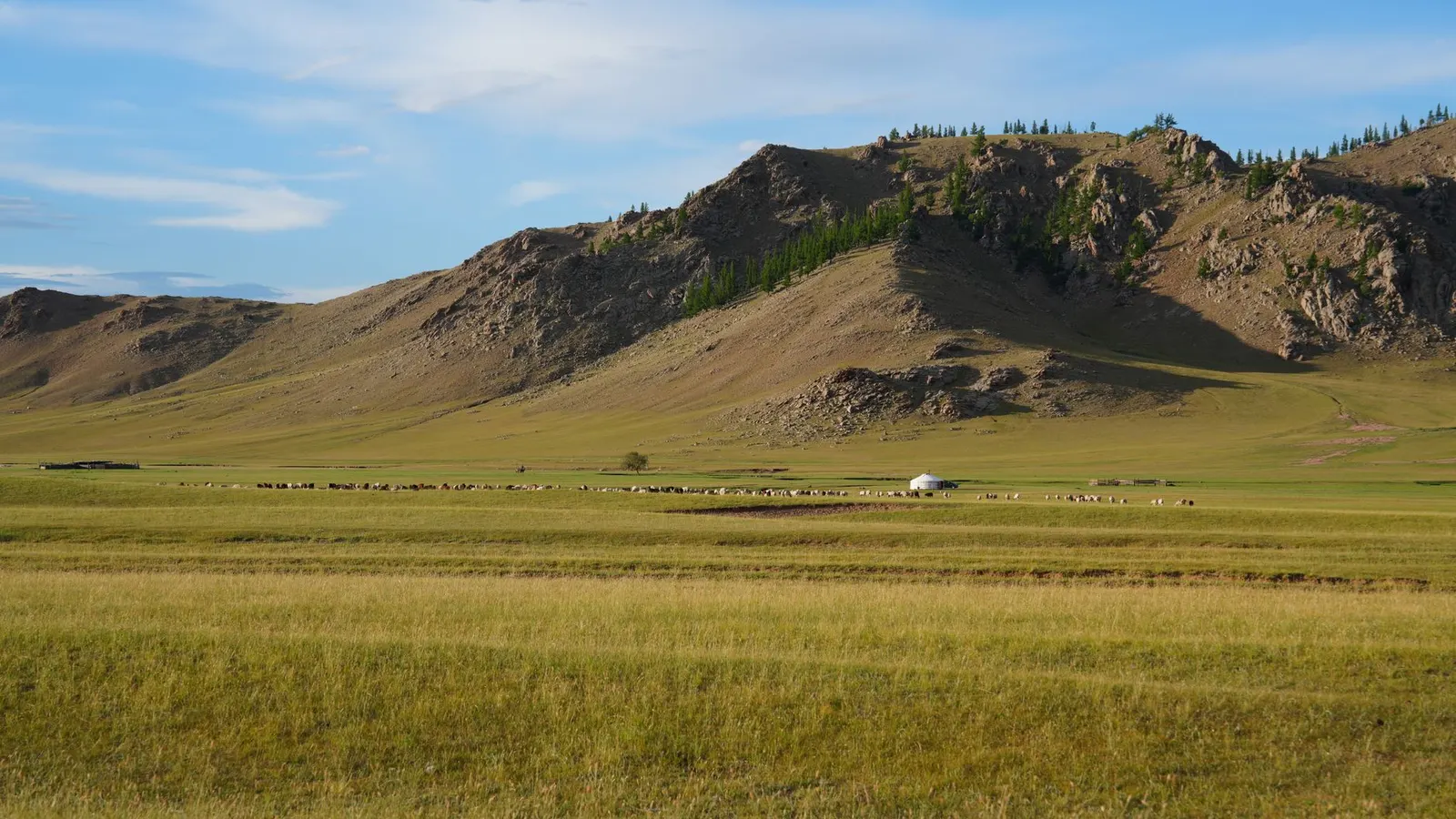
 Dal Tamiraa · Pexels License
Country Guide № 113 / 194 · Asia
Mongolia
The least densely populated country on earth, and it feels like it.
“The least densely populated country on earth, and it feels like it.”
Mongolia has three and a half million people in a country the size of Western Europe, half of them in Ulaanbaatar. What that produces is the emptiest travel on the continent: days of driving across grassland without a fence, herder families who will put you up in a ger because that is what you do, and a night sky with no light pollution for hundreds of kilometres.
It is also a country with a very short window. The summer, roughly June to early September, is when the roads are passable, the grass is green and Naadam is held. Winter is a serious proposition - minus forty in the Gobi is normal and Ulaanbaatar is the coldest capital city in the world. Most trips are two weeks of overland travel with a driver, a cook and a Russian van, and that is the right way to do it.
Chapter 01
Highlights
The Gobi Desert
The Flaming Cliffs where the first dinosaur eggs were found, the singing sand dunes of Khongoryn Els and the ice-filled Yolyn Am gorge. Four days minimum from Ulaanbaatar by road.
Naadam
The national festival in mid-July - wrestling, archery and cross-country horse racing ridden by children. The Ulaanbaatar stadium version is the big one; the provincial ones are better.
Lake Khövsgöl
A 136-kilometre alpine lake near the Siberian border, holding one per cent of the world's fresh water, with reindeer-herding Tsaatan communities in the taiga beyond.
Orkhon valley
The old imperial heartland - Karakorum, Genghis Khan's capital, and the Erdene Zuu monastery built from its stones, in a valley of waterfalls and herder camps.
Chapter 02
Entry requirements for Mongolia
Checking your passport…
up to 90 days · free entry
90 days on arrival
Before you fly
The detail
- Maximum stay
- up to 90 days
- Fee
- free entry
- Passport validity
- Most destinations want validity beyond your stay, and some want six months. Check yours against the return date.
- Onward travel
- Airlines may ask for a return or onward ticket at check-in.
- Health
- Hepatitis A, typhoid and tetanus are standard; rabies is worth serious consideration given dogs and marmots. Do not handle marmots - plague occurs in Mongolia and causes deaths most years, and quarantines have closed whole provinces. Tap water is not drinkable outside the capital. Medical facilities are limited outside Ulaanbaatar and evacuation from the Gobi or the far west is slow and expensive; insurance with evacuation cover is not optional.
- Money
- Cash outside the capital, always. ATMs exist in Ulaanbaatar and provincial centres (aimag capitals) and accept foreign cards; beyond them there is nothing. Cards work in the capital's hotels, restaurants and supermarkets. Carry enough tögrög for the whole overland leg plus a margin, and small notes for herder families and roadside stops.
A United States passport enters Mongolia without a visa for 90 days, and that allowance is worth understanding because it is not the same thing as the one most European visitors have. It comes from a long-standing bilateral arrangement rather than from the time-limited tourism scheme that has been extended repeatedly in recent years, which is why an American traveller has three months where a British one beside them has thirty days. The trap inside the 90 is registration: any stay of MORE THAN 30 DAYS must be registered with the immigration authority, in person, within the first week of arrival. It is enforced, the fine is charged on departure when it is too late to remedy, and it catches precisely the people the 90 days was generous to - the ones settling in for a summer. Under 30 days, nothing is required. The passport should be valid six months. Everything else about entering Mongolia is geography. Ulaanbaatar's Chinggis Khaan airport takes flights from Seoul, Beijing, Istanbul, Tokyo and seasonally Frankfurt; the Trans-Mongolian railway comes up from Beijing in about thirty hours and down from Russia, and is a destination rather than a connection. Overland road crossings exist with China and Russia, but several of them are open only to nationals of the two neighbouring countries, so check the specific crossing rather than the border - Zamyn-Üüd into China is the one that reliably takes everybody. Outside the paved corridors there are no roads, only tracks, and the country is travelled by 4x4 or UAZ van with a driver.
Check another destination with this passport →
Entry details: Editorial synthesis - Mongolian Immigration Agency registration rules, Ministry of Foreign Affairs visa-free arrangements (2025–2026) · compiled 18 Sept 2026
Who needs a visa for Mongolia
12 common passports| Passport | Requirement | Stay | Process |
|---|---|---|---|
| United States | Visa-free | up to 90 days | No process · €0 / $0 |
| United Kingdom | Visa-free | up to 30 days | No process · €0 / $0 |
| Germany | Visa-free | up to 30 days | No process · €0 / $0 |
| India | Visa on arrival | - | No Other passports record yet |
| China | e-Visa | - | No Other passports record yet |
| Brazil | Visa-free | up to 90 days | No Other passports record yet |
| Nigeria | Visa required | - | No Other passports record yet |
| Indonesia | e-Visa | - | No Other passports record yet |
| Philippines | Visa-free | up to 21 days | No Other passports record yet |
| Vietnam | Visa-free | up to 30 days | No Other passports record yet |
| Egypt | Visa required | - | No Other passports record yet |
| Nepal | e-Visa | - | No Other passports record yet |
Holding a passport that is not listed? The picker above answers for any of them. See where your passport takes you. Source: Passport Index, updated 14 Aug 2026.
Chapter 03
When to go
BestJun–Sep. AvoidNov–Apr.
Green steppe, wildflowers and long days before the crowds.
The band above each month is our editorial verdict - it weighs crowds, prices and access as well as weather. The line is average daily temperature, the bars are monthly rainfall. Select a month for the figures. Climate figures: ERA5 reanalysis via Open-Meteo, 2005–2024 normals.
Chapter 04
What it costs
A day in Mongolia
Comfortable · sample day
≈ $76
Line items are real prices we track. The daily budget is an editorial estimate for this level, not their sum.
Where this sits among 244 countries we have costed
The whole visitor economy operates from June to September and much of it physically closes the rest of the year - ger camps dismantle. Naadam week in July is the one genuine price spike, filling Ulaanbaatar hotels and domestic flights. Overland tour rates are quoted per vehicle per day, so the per-person cost depends almost entirely on how many people share the van.
Updated Aug 2026 · Editorial synthesis - Ulaanbaatar agency quotations, ger camp rates, MIAT published fares (2025–2026) · confidence medium
Excludes international flights - they depend on where you fly from.
Chapter 05
Regions to know
5Ulaanbaatar
Half the country's population - the Gandan monastery, the national museum and the Genghis Khan statue an hour east.
The Gobi
Dunes, dinosaur fossil beds, ice gorges and camel-herding families across the southern desert.
The Orkhon valley & central steppe
Karakorum and Erdene Zuu, waterfalls, hot springs and the grassland that defines the country.
Khövsgöl & the north
The great alpine lake, taiga forest and the reindeer-herding Tsaatan communities near the Siberian border.
The Altai & the west
Glaciated mountains, Kazakh eagle hunters around Ölgii, and the most remote travel in the country.
Chapter 06
Practical guide
Getting there
Ulaanbaatar Chinggis Khaan (UBN) takes flights from Seoul, Beijing, Istanbul, Frankfurt (seasonally), Moscow and Tokyo. The Trans-Mongolian railway connects Beijing and Moscow through Ulaanbaatar and is a destination in itself - the Beijing leg takes about 30 hours.
Getting around
Overland by 4×4 or Russian UAZ van with a driver, which is how essentially all visitor travel outside the capital happens. Domestic flights link Ulaanbaatar with Ölgii, Khovd and Mörön and save days of driving to the far west. Roads outside the few paved corridors are tracks across open ground; a journey of 300 km takes a full day. In Ulaanbaatar, taxis are informal - any car may stop - and ride-hailing apps operate.
Money & costs
Cash outside the capital, always. ATMs exist in Ulaanbaatar and provincial centres (aimag capitals) and accept foreign cards; beyond them there is nothing. Cards work in the capital's hotels, restaurants and supermarkets. Carry enough tögrög for the whole overland leg plus a margin, and small notes for herder families and roadside stops.
Safety
Rural Mongolia is very safe; Ulaanbaatar has a real pickpocketing and bag-slashing problem in crowded places, especially the State Department Store area and Naadam crowds. The genuine hazards are remoteness and weather - breakdowns hundreds of kilometres from help, sudden storms, and river crossings. Dogs at herder camps are working animals, not pets, and should be treated with caution. Winter air pollution in Ulaanbaatar from coal-burning gers is among the worst in the world.
Health
Hepatitis A, typhoid and tetanus are standard; rabies is worth serious consideration given dogs and marmots. Do not handle marmots - plague occurs in Mongolia and causes deaths most years, and quarantines have closed whole provinces. Tap water is not drinkable outside the capital. Medical facilities are limited outside Ulaanbaatar and evacuation from the Gobi or the far west is slow and expensive; insurance with evacuation cover is not optional.
SIM & internet
Mobicom and Unitel SIMs are cheap and coverage is far better than expected - signal reaches many rural areas and most soum centres. It disappears in the deep Gobi and the taiga. Wifi is standard in Ulaanbaatar and rare outside it. Carry a power bank and a solar charger for the overland legs; ger camps often run generators for only a few hours.
Chapter 07
Driving
Outside the paved corridors there are no roads, only tracks that fork and rejoin - navigation is by GPS and local knowledge, which is what the driver is for. Carry spare fuel, water and a satellite communicator if you go without one.
Rules change - verify with an official source before you rent.
ExplWorld VerifiedNo verified partners here yet - all 6 country seats are open.
Become ExplWorld Verified →Chapter 08
Itineraries through this country
Chapter 09
From the Journal
Chapter 10
Before you go
MongoliaChapter 11
Frequently asked questions
Do I need a tour?
Practically, yes, for anything outside Ulaanbaatar. There are almost no roads in the Western sense, no signage, no fuel stations for hundreds of kilometres and no public transport worth the name. The standard arrangement is a shared or private van with a driver and often a cook, arranged through a Ulaanbaatar agency or hostel, at €60–100 a day split between passengers. Self-drive is possible for the very experienced and well equipped.
What is a ger stay actually like?
A felt tent with beds around the edge, a stove in the middle, and no plumbing. Tourist ger camps have shared shower blocks and restaurants; staying with a herder family means a pit toilet and washing from a bowl. Both are comfortable in the way camping is comfortable. Bring a sleeping-bag liner, a head torch and small gifts.
Can I visit in winter?
Yes, and a few people do - for the Golden Eagle Festival in the far west in early October, or the ice festival on Khövsgöl in March. It means minus thirty to minus forty, limited road access and serious equipment. It is a specialist trip, not a variant of the summer one.