 Ramon Karolan · Pexels License
Country Guide № 127 / 194 · Europe
North Macedonia
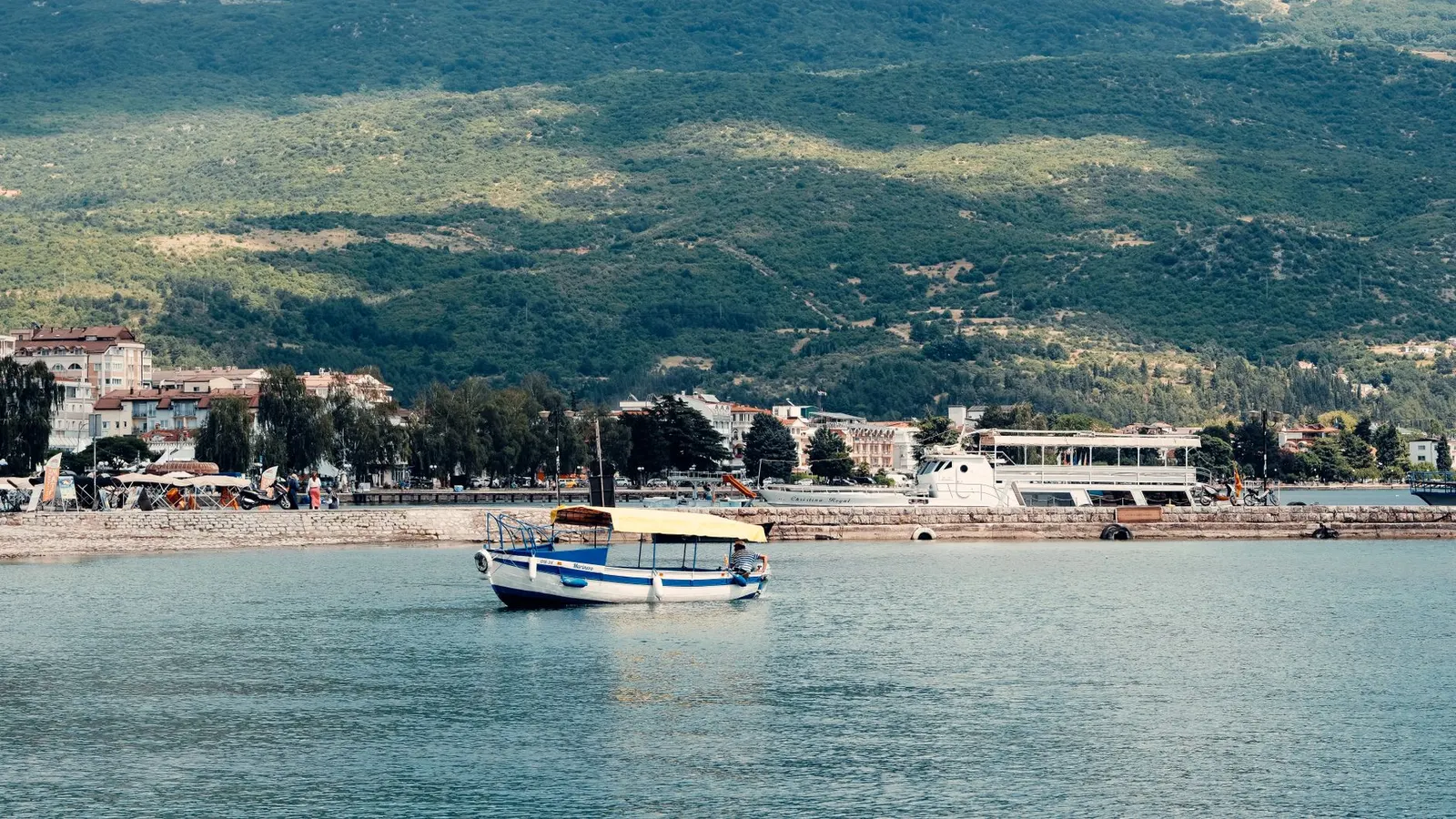
Lake Ohrid, Byzantine churches and mountains on every border.
“Lake Ohrid, Byzantine churches and mountains on every border.”
Lake Ohrid is the reason to come - one of the oldest and deepest lakes in Europe, around three million years old, with endemic species found nowhere else and a town on its shore that once claimed 365 churches. Both the lake and the town are UNESCO-listed, for nature and culture jointly, which is a rare combination.
The rest of the country is mountainous and lightly travelled. Mavrovo and Pelister national parks have marked trails and almost no walkers, the Šar mountains on the Kosovan border hold summer shepherd settlements, and Skopje is a strange and interesting capital where a 2014 state building programme covered the centre in neoclassical facades and enormous statues. It is inexpensive and the food is excellent.
Chapter 01
Highlights
Ohrid
A lakeside town of Byzantine churches, an amphitheatre and a fortress, on a lake three million years old. Sveti Jovan Kaneo on its cliff is the image of the country.
Skopje
The old bazaar and Ottoman bridge on one side, and on the other the Skopje 2014 project - a centre rebuilt with neoclassical facades and hundreds of statues, which is contested locally and genuinely fascinating.
Mavrovo and the Šar mountains
National park with the sunken church at Mavrovo lake, the Bigorski monastery's carved iconostasis, and long ridge walking on the Kosovan border.
Matka canyon
A gorge fifteen kilometres from Skopje with caves, a monastery and kayaking on a reservoir - the easiest half-day escape from a capital in the Balkans.
Chapter 02
Entry requirements for North Macedonia
Checking your passport…
up to 90 days · free entry
90 days on arrival
Before you fly
The detail
- Maximum stay
- up to 90 days
- Fee
- free entry
- Passport validity
- Most destinations want validity beyond your stay, and some want six months. Check yours against the return date.
- Onward travel
- Airlines may ask for a return or onward ticket at check-in.
- Health
- No vaccinations required. Healthcare is adequate in Skopje and limited elsewhere; EHIC does not apply, so insurance is necessary. Tap water is safe in the main towns. Tick-borne encephalitis is present in forests. Winter air pollution in Skopje and Tetovo is a genuine health concern for anyone with a respiratory condition.
- Money
- Denar. Cards are accepted in Skopje and Ohrid and less so elsewhere; carry cash. Exchange offices give good rates and are widespread. ATMs are common in towns. Tipping is rounding up or around 10 %.
North Macedonia admits a United States passport without a visa for 90 days in any 180. North Macedonia is not in the Schengen area and keeps its own count. Days spent here do not come out of the Schengen allowance of 90 days in any rolling 180, and days already spent in the Schengen area do not come out of what you are allowed here. The Schengen window rolls, so time spent outside the area restores it day for day. It is why the western Balkans are where a long European itinerary buys itself room: a visitor who has nearly exhausted a rolling Schengen window can cross into North Macedonia and let it recover while they travel. Registration with the police within 24 hours of arrival is required and hotels handle it as a matter of course; staying privately, it is yours to do at the local police station. The country’s name changed from Macedonia to North Macedonia in 2019 under the Prespa agreement, and the current form is what appears on every document, border sign and airline manifest - an older booking or an older passport endorsement in the previous name is worth correcting before you travel rather than explaining at a desk. The Greek frontier at Bogorodica and Evzoni is an external border of the Schengen area, and it is the busiest crossing in the country in August, when the Thessaloniki road carries most of the region’s summer traffic; the crossings from Kosovo, Serbia, Bulgaria and Albania are quieter. Skopje’s airport is small and most European connections run through Vienna, Istanbul or Belgrade. Your passport should be valid three months beyond the day you intend to leave.
Check another destination with this passport →
Entry details: Editorial synthesis - North Macedonian Ministry of Foreign Affairs visa policy, Ministry of Interior registration rules (2025–2026) · compiled 18 Sept 2026
Who needs a visa for North Macedonia
12 common passports| Passport | Requirement | Stay | Process |
|---|---|---|---|
| United States | Visa-free | up to 90 days | No process · €0 / $0 |
| United Kingdom | Visa-free | up to 90 days | No process · €0 / $0 |
| Germany | Visa-free | up to 90 days | No process · €0 / $0 |
| India | Visa required | - | No Other passports record yet |
| China | Visa required | - | No Other passports record yet |
| Brazil | Visa-free | up to 90 days | No Other passports record yet |
| Nigeria | Visa required | - | No Other passports record yet |
| Indonesia | Visa required | - | No Other passports record yet |
| Philippines | Visa required | - | No Other passports record yet |
| Vietnam | Visa required | - | No Other passports record yet |
| Egypt | Visa required | - | No Other passports record yet |
| Nepal | Visa required | - | No Other passports record yet |
Holding a passport that is not listed? The picker above answers for any of them. See where your passport takes you. Source: Passport Index, updated 14 Aug 2026.
Chapter 03
When to go
BestMay–Jun, September. AvoidNov–Feb.
The best month - warm, green and Ohrid still quiet.
The band above each month is our editorial verdict - it weighs crowds, prices and access as well as weather. The line is average daily temperature, the bars are monthly rainfall. Select a month for the figures. Climate figures: ERA5 reanalysis via Open-Meteo, 2005–2024 normals.
Chapter 04
What it costs
A day in North Macedonia
Comfortable · sample day
≈ $54
Line items are real prices we track. The daily budget is an editorial estimate for this level, not their sum.
Where this sits among 244 countries we have costed
Ohrid is the one seasonal market - accommodation roughly doubles in July and August with regional holiday demand and during the summer festival, and is very cheap otherwise. Skopje and the interior are flat year-round. Mavrovo has a small winter ski peak.
Updated Aug 2026 · Editorial synthesis - accommodation and operator sampling, site tariffs (2025–2026) · confidence medium
Excludes international flights - they depend on where you fly from.
Chapter 05
Regions to know
5Skopje & the north
The capital with its bazaar and statues, Matka canyon, and the Šar mountains toward Kosovo.
Lake Ohrid
The ancient lake, Ohrid town's churches and fortress, Sveti Naum monastery and the Albanian shore beyond.
Mavrovo & the west
National park with the sunken church, the Bigorski monastery, Galičnik's wedding festival and skiing in winter.
Pelagonia & the south
Bitola's boulevard and the Roman ruins of Heraclea, Pelister national park, and Prilep's tobacco country.
The east
Kratovo's towers and volcanic landscape, the Kokino megalithic observatory and the Osogovo monastery.
Chapter 06
Practical guide
Getting there
Skopje (SKP) and Ohrid (OHD) take low-cost flights from across Europe, with Wizz Air the main operator. Buses reach Sofia, Belgrade, Tirana, Pristina and Thessaloniki cheaply. The rail network is very limited and slow.
Getting around
Buses connect the main towns and are cheap and reasonably frequent. A car is genuinely useful for the mountains and the smaller monasteries - the road from Skopje to Ohrid through Mavrovo is the scenic route and worth taking over the motorway. Skopje has city buses; Ohrid is walkable. Taxis are inexpensive and metered.
Money & costs
Denar. Cards are accepted in Skopje and Ohrid and less so elsewhere; carry cash. Exchange offices give good rates and are widespread. ATMs are common in towns. Tipping is rounding up or around 10 %.
Safety
Safe, with petty theft the main risk and taxi overcharging at the airport a minor one. Driving standards are the practical hazard, along with mountain roads that are narrow and unlit. Political demonstrations occur in Skopje and are generally peaceful. Air quality in Skopje in winter is severe - the city regularly ranks among the most polluted in Europe.
Health
No vaccinations required. Healthcare is adequate in Skopje and limited elsewhere; EHIC does not apply, so insurance is necessary. Tap water is safe in the main towns. Tick-borne encephalitis is present in forests. Winter air pollution in Skopje and Tetovo is a genuine health concern for anyone with a respiratory condition.
SIM & internet
Not in the EU; Western Balkans roaming and some EU plans cover it. Local SIMs are cheap. Coverage is good in towns and along main roads, patchy in the mountains. Wifi is standard in accommodation.
Chapter 07
Driving
Winter equipment is mandatory from mid-November to mid-March. Mountain roads including the Mavrovo route are winding and slow, and the drive from Skopje to Ohrid takes three hours despite the modest distance.
Rules change - verify with an official source before you rent.
ExplWorld VerifiedNo verified partners here yet - all 6 country seats are open.
Become ExplWorld Verified →Chapter 08
Itineraries through this country
Chapter 09
From the Journal
Chapter 10
Before you go
North MacedoniaChapter 11
Frequently asked questions
What is the name situation?
The country changed its name from Macedonia to North Macedonia in 2019 under the Prespa agreement with Greece, which unblocked its NATO accession and EU candidacy. Both names are in use colloquially; the official one is North Macedonia and it is what appears on documents and signage.
How long do I need?
Five to seven days covers Skopje, Ohrid and one mountain area. Ohrid deserves at least two nights, Skopje one or two, and the drive between them through Mavrovo is worth taking slowly. Add the Pelister or Šar mountains if you want to walk.
Is it good value?
Among the cheapest in Europe. A restaurant main runs €6–9, a beer €1.80, a mid-range hotel €45. Ohrid in July and August is the one place where prices rise meaningfully, driven by domestic and regional holidaymakers.