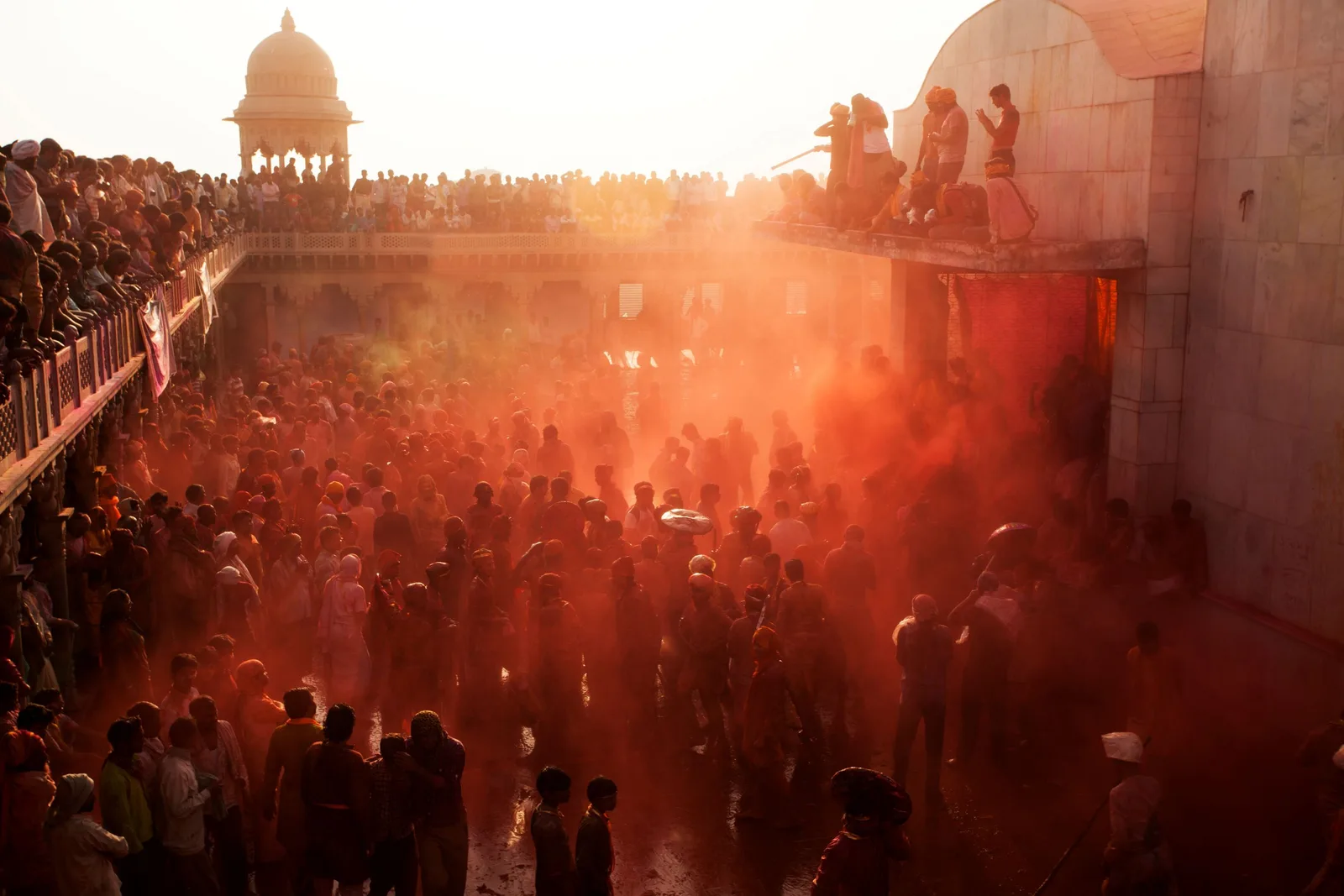
 Partha / stock.adobe.com
Report · Culture & Place
Every Rule Is a Record of Something
Ticketing, separation, enforced behaviour rules, closure. The four ways a community responds when enough outsiders want to watch what it does for itself - and how to tell a procession from a parade before you raise a camera.
A festival is a community doing something for itself. When enough outsiders want to watch, the community faces a decision it did not ask for: adapt, restrict, charge, move, or stop. Every large festival in a visited country has made that decision, usually more than once, and the version a visitor attends is the result.
The responses, in order of frequency
Ticketing and capacity limits. The commonest and the least contentious - a fixed number of places, sold in advance, often with a resident allocation held back and priced differently. It converts an open event into a managed one, and it is usually adopted after a specific incident rather than in principle: a crush, an injury, a year when the square simply could not hold the people in it.
Separation. Two versions: a public, scheduled, accessible one for visitors and media, and a closed one for participants at a different time or in a different place. This preserves the thing while satisfying the demand, and of all the responses it is the one that has held up best over decades. It requires a community confident enough to say that the visible version is not the whole of it.
Behaviour rules with actual enforcement. Dress codes at religious events, photography bans, prohibitions on entering particular spaces or crossing particular lines, alcohol restrictions, bans on drones. Some of these - modesty at a shrine - are internal religious norms far older than tourism that bind everyone present; what visitors caused is their codification onto signs and their enforcement, which falls mostly on visitors and is frequently newer and considerably stricter than a guidebook printed three years ago suggests.
Closure. The rarest and the clearest signal. A number of ceremonies across several continents have been closed to outsiders entirely, in most cases after specific and documented incidents of disruption - a filmed rite, an interrupted procession, a sacred object photographed against an explicit prohibition.
Most rules at a festival were written after something happened. The rule is the record of what a visitor did.
The religious dimension
A large proportion of the world’s major festivals are religious observances, and the distinction between an event and a rite is not always visible to someone who did not grow up with it. A procession may be a devotional act in which the participants are not performing and are not aware of an audience in any sense that includes you. Photographing it is not automatically wrong, and there is no universal rule - but whether to ask first is answered differently by a procession and by a parade, and telling which one you are looking at is the actual skill.
The rough test: is there a route, a barrier and an announcer, or is there a group of people doing something with their attention entirely inside it. The second is not a show, whatever the crowd around it suggests.
The commercial pressure
The quieter change is the one nobody legislates. A festival that draws visitors acquires sponsors, a stage, a schedule that suits broadcast, a merchandise stall and a version that starts at a time convenient for a coach party. None of that is imposed; each step is agreed by a committee for good reasons, usually money the event needs.
The events that have kept their shape are generally the ones where the participants, rather than a tourism board, decide the timetable - and where somebody had the standing to say no to a broadcaster.
How to attend well
Find the published rules and read them before arriving, because most festivals now publish them and most visitors do not read them. Book far ahead: capacity limits mean beds within reach sell out months out and prices reflect it, and the accommodation nearest a famous festival is frequently sold a year in advance.
Ask a local person, not a guide selling access, whether visitors are welcome at the specific event - the answer differs between two festivals in the same town in the same week, and a guide with a ticket to sell is not a neutral source.
Stand where you are directed. Do not enter roped or marked areas, which are almost always the participants’ space rather than a better view. Put the phone down for part of it, which improves the experience as well as the optics. And if you are asked to stop doing something, stop immediately and without discussion - the person asking is at their own event, and you are a guest at it.
Sources
- The festival’s own published visitor rules
Most large festivals now publish capacity, dress, photography and access rules; the current year’s version supersedes every guidebook.