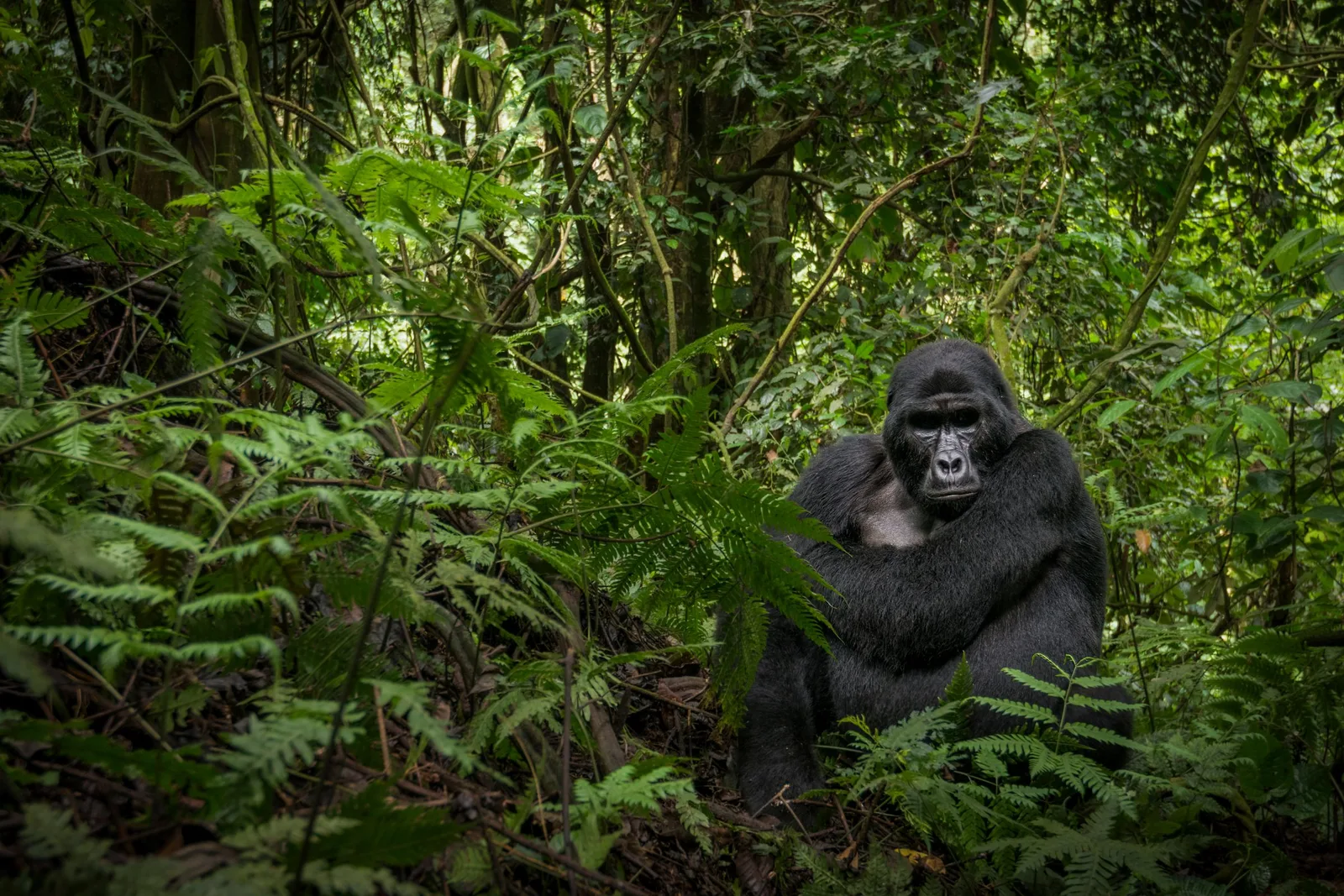
 Roger de la Harpe / stock.adobe.com
Feature · Nature & Environment · Borders & Mobility · Rwanda
The Border the Gorillas Ignore
Roughly a thousand mountain gorillas live across three countries: one at war and under an Ebola emergency, one that has just ended its own outbreak, and one selling the world’s most expensive wildlife permit. A thousand kilometers west, their lowland cousins can be visited in three more countries including the forest where Ebola once killed five thousand of them. What a visit in 2026 actually involves, what it costs and what it costs the animals.
This text is a verified snapshot as of August 31, 2026. Permit prices, park status and entry rules are dated to the source that reported them and will change. Before booking, verify with the Rwanda Development Board, the Uganda Wildlife Authority, the park authorities and operators for Gabon, the Republic of the Congo and the Central African Republic, and the entry-requirement pages for each country, which carry their own verification dates.
There is no fence on the summit of Mount Sabyinyo. Its three-way border Rwanda, Uganda, the Democratic Republic of the Congo is a line on a map that runs through bamboo, and the gorillas cross it whenever the bamboo on the other side is better. The last complete count of the Virunga Massif population, in 2016, found a minimum of 604 mountain gorillas living on the volcanoes shared by the three countries. The last count of the second habitat, Uganda's Bwindi Impenetrable Forest and the adjoining Sarambwe reserve in the DRC, found 459 in 2018. Together, 1,063 - a number that made the mountain gorilla the only great ape whose population is known to be rising, and that moved it in 2018 from Critically Endangered to Endangered on the IUCN Red List.
The humans who want to see them face a border the gorillas do not. In 2026, the same animal can be visited legally in Rwanda for US$1,500 an hour, in Uganda for US$800, and in the DRC on paper for US$400 in a park that has been closed to tourists since armed groups attacked it in December 2024 and the M23 movement took the gateway city of Goma the following month. Since May, the DRC has also been the center of the largest Ebola outbreak in its history, a virus to which gorillas are known to be lethally susceptible. Uganda imported twenty cases of that outbreak, contained them, and was declared free of it on August 26. Rwanda, which has had no case, quarantines arrivals from the DRC and keeps its park open.
The mountain gorilla is not the only gorilla a visitor can see. Its western lowland cousin far more numerous, at roughly 360,000 by a 2018 estimate, yet listed as Critically Endangered because its numbers are falling fast is habituated for tourism in exactly three places: Odzala-Kokoua in the Republic of the Congo, Dzanga-Sangha in the Central African Republic and Loango in Gabon. Two of those three countries border the DRC and sit inside WHO's high-risk group for the current outbreak. One of them, Odzala, lies beside the forest where Ebola killed an estimated five thousand gorillas two decades ago. A fourth subspecies, the Cross River gorilla of the Nigeria-Cameroon border, numbers fewer than 300 and has never been habituated for visitors. This text covers all four: the three that can be visited across six countries, and the one that cannot.
This is a feature about how to visit an animal whose survival depends on three governments that agree on almost nothing except that the gorilla must not catch what people carry. It is built, like every ExplWorld verified text, on the principle that a price, a count and a rule are only as good as the institution and the date behind them.
The State of the Data
Item | Institution and date | Figure |
|---|---|---|
Mountain gorilla population | Virunga census 2016 (604) + Bwindi–Sarambwe census 2018 (459), via IGCP and Dian Fossey Gorilla Fund | 1,063 minimum; new Bwindi–Sarambwe census conducted May–Oct 2025, official results not located as of Aug 31, 2026 |
IUCN status | IUCN Red List, 2018 | Endangered (previously Critically Endangered) |
Rwanda permit | Rwanda Development Board tariff, as reported by SafariBookings (July 2026) and operators | US$1,500 foreign non-resident; 30% low-season discount (Nov–May) conditional on additional nights in Akagera and Nyungwe; roughly 96 permits per day |
Uganda permit | Uganda Wildlife Authority tariff, as reported by operators (2026) | US$800 foreign non-resident; US$500 other African nationals; habituation experience US$1,500, rising to US$1,800 from Jan 1, 2027; ~152 standard + 8 habituation permits daily in Bwindi, 8 in Mgahinga |
DRC permit | ICCN tariff as reported by operators | US$400 (Virunga), lower in Kahuzi-Biega - Virunga closed to tourism since December 2024; Kahuzi-Biega status disputed between sources (see Part II) |
Western lowland gorilla population | Strindberg et al., Science Advances (2018), led by WCS | roughly 360,000 (2013 estimate); IUCN Critically Endangered |
Republic of the Congo - Odzala-Kokoua | operator itineraries and press (Jan 2026 – 2026) | 2 habituated groups; permits bundled into packages; extra trek US$750 cash; 7 nights about US$14,500; open |
Central African Republic - Dzanga-Sangha | operator reporting (June 2026); program rules (2020) | 2–3 habituated groups (sources differ); 3 visitors per visit; bundled pricing; described as operational under a Level 4 country advisory |
Republic of the Congo - Nouabalé-Ndoki (Mondika) | WCS Congo; operator reporting (2026) | 2 habituated groups (Kingo, Mététélé); permit about US$750; open |
Gabon - Loango | Loango gorilla program (Max Planck / ANPN); operator reporting (July 2026) | 1 habituated group (Atananga); 4 visits per week, 4 guests each; bundled pricing; open |
Cross River gorilla population | WCS Nigeria; UNESCO tentative-list entry (2014 survey) | fewer than 300, under 250 mature; Critically Endangered; no habituated groups; no tourism |
Ebola | WHO, DRC INSP (data to Aug 29, 2026) | DRC: 6,041 confirmed cases, 2,911 deaths, six eastern provinces; Uganda: outbreak declared over Aug 26 (WHO) |
Visiting rules (all parks) | UWA / RDB / ICCN standing rules | 1 hour with a family; max 8 visitors; minimum age 15; 7 m minimum distance; masks mandatory in proximity; no visit if ill |
Permit prices are government tariffs reported through licensed operators and a booking platform; neither RDB nor UWA publishes a single consolidated tariff page that this text could cite directly, which is itself a finding.
Before You Book: Five Things to Verify
A reusable check for any permit-based wildlife visit.
- The tariff and its date. Permit prices are set by the park authority and change on announced dates - Uganda's habituation permit rises on January 1, 2027. A price on an operator's page is a claim about a tariff; ask for the tariff.
- Whether the park is open. "Permits available" and "park open to tourists" are different statements. Virunga's permit price still circulates on operator pages eighteen months after the park closed.
- Which sector the permit is for. Bwindi has four trekking sectors with separate trailheads hours apart; a permit for Rushaga and a lodge in Buhoma is a common and expensive mistake.
- The health rules on both sides of the encounter. Every park screens visitors to protect the gorillas. In 2026 that screening sits inside a national Ebola protocol, and the rules for entering the next country after your trek may reference the one you trekked in.
- What the count actually says. "Over a thousand gorillas" is the 2016–2018 minimum. A newer census exists but its results had not been officially published at this text's cutoff, and a widely shared social-media figure above 1,100 could not be traced to IGCP or the Greater Virunga Transboundary Collaboration.
PART I - THE ANIMAL
1. One Population, Three Flags
Gorilla beringei beringei is a subspecies of the eastern gorilla, and it lives in exactly two places on earth. The first is the Virunga Massif, a chain of eight volcanoes whose forested upper slopes are divided among Rwanda's Volcanoes National Park, Uganda's Mgahinga Gorilla National Park and the DRC's Virunga National Park. The second is the Bwindi Impenetrable Forest in southwestern Uganda, with the small Sarambwe reserve just across the Congolese line. The two habitats are about 25 kilometers apart and are not connected; a gorilla born in Bwindi has never met one from the volcanoes.
Every five to ten years since 1971 the three countries have counted them together, sweeping the forest for night nests and collecting dung for genetic analysis so that no group is counted twice. The 2016 Virunga sweep found a minimum of 604 in 41 groups; the 2018 Bwindi–Sarambwe sweep found 459 in 36 groups and 16 solitary males (Dian Fossey Gorilla Fund; IGCP). The next Bwindi–Sarambwe census began in May 2025, led by the International Gorilla Conservation Programme with the Uganda Wildlife Authority and the Congolese conservation institute ICCN, and ran a second sweep in October 2025 to reduce the chance of missing animals. Results were expected in 2026. As of August 31 this text could locate no official publication of them.
That matters because the number is the whole argument for the industry. The mountain gorilla is the one great ape whose population is documented to be growing - from an estimated 620 in 1989 to 1,063 by the last full count - and the daily presence of trackers, rangers and paying visitors is the mechanism that protects it. A census that shows continued growth validates the model; a census that shows the opposite would be the most important travel story of the decade. Until the number is published by the institutions that counted, ExplWorld reports the 2016–2018 minimum and nothing newer.
The animal's own geography ignores the political one. Gorilla groups cross between Rwanda, Uganda and the DRC on the Virunga slopes as a matter of routine, which is why the census, the veterinary program and the transboundary collaboration exist. It is also why a disease outbreak on one side of the line is, for the gorillas, an outbreak on all three.
2. Why a Cold Can Kill a Gorilla
Gorillas share roughly 98 percent of their DNA with humans and, with it, a susceptibility to human respiratory infections against which they have no immunity. The rules that govern every trek - one hour, a maximum of eight visitors, a minimum distance of seven meters, no visit for anyone with a cough or fever - were written for that reason long before 2020. Masks in proximity were added by the park authorities during the COVID-19 pandemic and have not been withdrawn.
Ebola is a different order of threat. Between 2002 and 2004, Zaire ebolavirus killed an estimated 5,000 western lowland gorillas in and around the Lossi sanctuary in the Republic of the Congo, according to a study published in Science in 2006 (Bermejo et al.). That was a different species of gorilla, a different species of the virus, and a different ecosystem; there is no recorded case of Ebola in a mountain gorilla. But the 2026 outbreak in the DRC is the first large Ebola epidemic to occur within a few hundred kilometers of the Virunga Massif while the massif's own national park is closed, its ranger posts partly abandoned, and its gorillas unmonitored by tourism for the first time in years.
For a visitor, the practical consequence is that the health screening at a trek briefing - a temperature check, a questionnaire, a ranger's visual assessment - has become the last line of a national Ebola protocol rather than a formality. Uganda's wildlife authority stated in May that its parks were operating under heightened biosafety standards with rangers trained in infection prevention; Rwanda's health ministry added Ebola-related entry rules for arrivals from the DRC in the last week of May. Neither park has suspended trekking. Both have made it harder to trek while sick, which is the point.
PART II - THE THREE COUNTRIES IN 2026
3. Rwanda: The US$1,500 Model
Rwanda's permit is the most expensive wildlife permit in Africa and the country intends it that way. The Rwanda Development Board set the foreign non-resident price at US$1,500 in 2017, doubling it overnight from US$750, and has held it there since; the 2026 tariff reported by SafariBookings and by every operator this text checked is unchanged. Roughly a dozen habituated families in Volcanoes National Park, at eight visitors each, yield in the region of 96 permits a day. They sell out months ahead in the June–October dry season.
The model is explicitly high-value, low-volume: fewer visitors paying more, with the surplus funding protection and a revenue-sharing scheme for communities around the park. A conditional discount exists - 30 percent off, to about US$1,050, for international visitors in the November–May low season who also book two or more nights across Akagera and Nyungwe national parks - and is designed to spread visitors to the rest of the country. It does not apply in the peak months.
Rwanda has had no Ebola case in the 2026 outbreak. It is, however, in the group of nine countries bordering the DRC that WHO assessed on August 14 as facing a high regional risk, and it responded early: mandatory quarantine for arrivals from the DRC from May 23 (Anadolu), followed by further health-ministry rules in the last week of May. The practical effect for a gorilla visitor arriving from Europe or North America is a temperature check at Kigali airport and at the trek briefing; the practical effect for anyone who has been in the DRC in the previous three weeks is a quarantine.
The road from Kigali to the park headquarters at Kinigi is about three hours of tarmac. The convenience is part of what the US$1,500 buys, and it is why Rwanda is the default choice for a first-time visitor with four days and a fixed budget for lodging that is, by regional standards, expensive.
4. Uganda: US$800 and an Outbreak That Ended
Uganda holds more of the world's mountain gorillas than any other country - the 459 counted in Bwindi–Sarambwe in 2018 plus a single habituated group in Mgahinga - and sells the permit at US$800 for foreign non-residents, the price the Uganda Wildlife Authority set in July 2024. Nationals of African countries outside the East African Community pay US$500; East Africans pay in shillings. Bwindi's four sectors - Buhoma, Ruhija, Rushaga and Nkuringo - offer about 152 standard permits a day across nineteen habituated families, plus eight permits for the four-hour Gorilla Habituation Experience in Rushaga, at US$1,500 now and US$1,800 from January 1, 2027. Mgahinga adds eight.
Two details are contested between sources and are flagged rather than resolved here. Several operators report a low-season standard permit of US$600 in April, May and November 2026; at least one states that no low-season discount has existed since July 2025. The tariff should be confirmed with UWA before relying on either. And the minimum age of 15 is described by every source as absolute, which in Uganda's case appears to be true.
Uganda's 2026 has been shaped by an outbreak that did not reach its parks. The country declared Ebola on May 15 after two confirmed cases in Kampala, both traced to travel from the DRC; it closed the DRC border on May 27, suspended flights and cross-border transport, isolated an estimated 6,000 contacts for 21 days, and recorded 20 confirmed cases and two deaths in total, 15 of them in people who had come from the DRC. The last case was on June 21. The Ministry of Health declared the outbreak over on July 28 and WHO confirmed it on August 26 after 42 days without a new case. Bwindi and Mgahinga, in the far southwest near the Rwandan border and the DRC's South Kivu - a province with no confirmed case since May 29 - were never inside an affected zone. UWA stated in May that trekking continued under enhanced protocols, and operator reporting through August describes normal operations.
What Uganda's outbreak did change is the rules after the trek. Entry restrictions announced in May by the United States, Canada, Bahrain, Jordan, Thailand, Vietnam and others named Uganda alongside the DRC and South Sudan. Uganda's outbreak is now over; not all of those rules had been withdrawn by August 31. A traveler who treks in Bwindi and flies onward to a country whose Ebola rules still list Uganda may face screening, monitoring or, for non-citizens in some cases, a bar on entry. The service appendix covers this; it is the single most consequential thing about a Uganda gorilla trip in 2026 that operator pages do not mention.
5. DRC: The Closed Park and the Disputed One
Virunga National Park is Africa's oldest, a UNESCO World Heritage site, and home to roughly a third of the Virunga Massif's gorillas. It has been closed to tourism since December 2024, when armed groups attacked the park and surrounding communities; in January 2025 the M23 movement took Goma, the city through which every visitor to Virunga had passed, and in February 2025 it took Bukavu. The park's own rangers have been killed in attacks on their positions, and patrol posts inside the park have been abandoned (operator reporting; Valiant Safaris, June 2026). The US$400 permit still appears on booking pages. There is nothing to book.
Kahuzi-Biega National Park, near Bukavu in South Kivu, is the only place on earth with habituated eastern lowland gorillas - a different subspecies, larger and rarer, whose population collapsed by an estimated 77 percent between 1994 and 2015 according to a study by the Wildlife Conservation Society and partners. Its status in 2026 is the one point on which this text's sources contradict each other outright. Gorilla Highlands, a regional tourism collective reporting from Bukavu in late 2025, wrote that eight months after M23 took the city the national parks were closed. Several operators state that Kahuzi-Biega remains open with ICCN ranger escorts. A promotional site describes both Virunga and Kahuzi-Biega as operating with an excellent safety record - a claim contradicted by every other source on Virunga. A confirmed Ebola death was recorded in Bukavu on May 21.
ExplWorld's position is the one the evidence supports: Virunga is closed; Kahuzi-Biega's status is disputed and cannot be verified from published ICCN communication, which this text could not locate; North and South Kivu are under Level 4 "do not travel" advisories from the United States, the United Kingdom and most Western governments; Ituri and North Kivu are additionally under a CDC Level 4 health notice as of August 28; and the U.S. government has stated it has extremely limited ability to assist its citizens in the Kivus. Whether an operator can physically take a visitor to a gorilla in the DRC in 2026 is, on this evidence, a different question from whether anyone should ask them to.
PART III - THE MONEY AND THE HOUR
6. Where the Money Goes
The permit is the price of protection, and each country distributes it differently.
Rwanda's revenue-sharing policy returns a fixed share of tourism revenue - 10 percent under the scheme introduced in 2005 - to communities around its national parks, funding schools, water systems and health posts; the country has said publicly that gorilla tourism funds the majority of its park budget. Uganda's policy, under the Uganda Wildlife Act, returns 20 percent of park entry fees to neighboring communities and adds a fixed contribution from each gorilla permit. In both countries the argument is the same: a gorilla is worth more alive, seen once an hour by eight people, than dead - and the people who live at the forest edge must be the ones who profit from that arithmetic, or they will not defend it.
The figures that circulate for what gorilla tourism earns each country - tens of millions of dollars a year in permit revenue, thousands of jobs - appear on operator pages without a primary source and are not repeated here. What can be said is that Rwanda's 2017 price rise was a deliberate bet that the market would pay double for scarcity, and that nine years later the permit sells out.
Beyond the permit, the trip is where the money goes. Operators consistently describe a realistic Uganda gorilla trip at US$2,000–2,500 per person at mid-range before international flights, and Rwanda at roughly double, driven by lodge prices around Volcanoes that begin where Uganda's end. A porter - hired at the trailhead, usually from the community - costs a fraction of any of this and is the most direct payment a visitor makes to a person whose livelihood depends on the forest staying forest.
7. The Hour
Every mountain gorilla permit buys the same thing: one hour with one habituated family, in a group of no more than eight, at a distance the rangers enforce, after a trek that may last forty minutes or six hours depending on where the family slept the night before. The rules exist because habituation - the years-long process of teaching a wild group to tolerate humans at close range - is a trade the gorillas did not agree to. The hour is short because the animals' stress rises the longer people stay; the distance is seven meters because that is the range beyond which a sneeze is unlikely to carry; the mask is mandatory because the seven meters are often not kept; the minimum age is fifteen because children get sick more often and behave less predictably.
There is a version of this experience being marketed in 2026 as a bucket-list item, an Instagram encounter, a luxury. That version is not false - the lodges exist, and the photographs are extraordinary - but it is not the reason the industry exists. The reason is that the alternative to eight tourists an hour is no rangers, and the alternative to no rangers, in this landscape, is snares, charcoal and, in one of the three countries, men with guns living inside the park.
A visitor in 2026 who wants to know whether the trip is responsible has a workable test. It is not whether the gorillas seem happy, which a person cannot judge in an hour. It is whether the money reaches the people at the forest edge, whether the visitor's own health screening was taken seriously, and whether the trip stays inside the two countries where the system that protects the animal is currently functioning.
PART IV - THE OTHER GORILLA
8. Western Lowland: Where Ebola Actually Happened
The mountain gorilla is the rarest gorilla and the one nearly every visitor sees. It is not the only one that can be seen. The western lowland gorilla - Gorilla gorilla gorilla - lives across the Congo Basin from Cameroon to the Republic of the Congo, and a 2018 survey led by the Wildlife Conservation Society estimated roughly 360,000 of them (Strindberg et al., Science Advances). It is nevertheless listed by IUCN as Critically Endangered, a more severe category than the mountain gorilla's, because its numbers are falling fast across forests that are vast, remote and thinly protected. Ebola is part of that history in a way it has not yet been for the mountain gorilla: the estimated 5,000 gorillas the Bermejo study found dead between 2002 and 2004 were western lowland gorillas in and around the Lossi sanctuary in the Republic of the Congo's Cuvette-Ouest, beside Odzala-Kokoua National Park. The booking platform Responsible Travel summarizes the same period as a loss of 70 to 95 percent of Odzala's gorillas, once estimated at around 20,000 - a figure this text gives as the platform's, not its own.
Habituated western lowland gorillas can be visited in exactly three places, each with one to three habituated groups, three or four visitors per visit, and prices that, unlike the mountain gorilla parks, are almost never published as a standalone tariff. Two of the three countries border the DRC and were placed by WHO on August 14 in the high regional risk group for the 2026 outbreak.
9. Republic of the Congo: Odzala-Kokoua and Nouabalé-Ndoki
Odzala-Kokoua, in the country's northwest on the equator, is the most developed of the three: three lodges run by Kamba African Rainforest Experiences (Ngaga, Lango and Mboko), reached by a two-hour flight north from Brazzaville and a further two to three hours by road, with two habituated groups tracked in the company of researchers (Responsible Travel). Gorilla permits are bundled into packages; an additional trek costs US$750 per person, payable in cash at camp (Africa Geographic, 2026 itinerary). A seven-night program with two days of tracking was priced at £10,750 - about US$14,500 - per person in January 2026, including domestic flights, permits, the visa and the letter of invitation the Republic of the Congo requires before a visa is issued (The Week, January 9, 2026). The country shares the Congo River as its border with the DRC, and Brazzaville faces Kinshasa across it; WHO placed it in the high-risk group on August 14. No Ebola-specific entry measure aimed at tourists could be located as of August 31; the camps' own health screening of trekkers applies.
Nouabalé-Ndoki, in the far north on the CAR border, is the Republic of the Congo's second site and the scientific one. Gorillas in the Djéké Triangle have been studied continuously from the Mondika research camp since 1995, under the Wildlife Conservation Society since 2005; the triangle itself, 95 square kilometers of unlogged forest, was gazetted into the national park in June 2023 (WCS, via ATIBT). Two groups are visited - one named for the silverback Kingo, habituated in 2000, and the newer Mététélé group - under protocols the site describes as scientific management, with masks provided and distance enforced. Tourism, run with the Congo Conservation Company since 2021, reaches Mondika by road to Bomassa and a forest walk of one and a half to two and a half hours; an operator quotes a 2026 tracking permit of about US$750 and calls it the most expensive western lowland trek because of the logistics (Kwafrika Travel, 2026). The park is the Congolese third of the Sangha Trinational, contiguous with Dzanga-Sangha across the CAR line.
10. Central African Republic: Dzanga-Sangha
Dzanga-Sangha, in the country's southwestern corner where it meets Cameroon and the Republic of the Congo, is part of the UNESCO-listed Sangha Trinational with Nouabalé-Ndoki and Lobéké. Tracking runs from the Bai Hokou research camp, about 35 kilometers from the village of Bayanga, under a habituation program long supported by WWF. Sources disagree on how many groups are currently habituated for visits - a 2020 program description says two, a June 2026 operator says three - and the older description of the rules is the specific one: two visits per group per day, three visitors per visit. Two lodges serve the reserve, Sangha Lodge on its own concession and Doli Lodge. Access is by charter from Bangui or overland and by river through Cameroon's Libongo crossing or the Republic of the Congo's Ouesso. Operators describe the reserve as operational in 2026 and taking bookings into 2027 while acknowledging that Level 4 "do not travel" advisories apply to the country as a whole; that combination - a secured enclave inside a country under the highest advisory - is a claim to weigh, not a guarantee. One operator's 2025 itinerary required proof of COVID-19 vaccination and a rapid antigen test before the trek, the strictest visitor-health rule this text found anywhere in gorilla tourism. CAR borders the DRC and is in WHO's high-risk group. Visas must be arranged before travel, through the operator.
11. Gabon: Loango
Loango, on Gabon's Atlantic coast, is the one western lowland site outside WHO's high-risk group; Gabon has no border with the DRC. A single group, the Atananga group, has been habituated since 2014 and visited by tourists since 2016 under a program run by the Max Planck Institute for Evolutionary Anthropology with Gabon's national parks agency ANPN; visits are limited to four per week and four guests each (Loango gorilla program; Trek Africa Expeditions). Treks run from the Yatouga research camp and are described as 45 minutes to two hours on flat, humid terrain, with January to May the best months because fruiting keeps the group near the trails. Access is via Port-Gentil, then road and boat to the Iguela lagoon. Gabon requires a visa before arrival and a yellow fever certificate at every entry point (operator reporting, July 2026). Permit prices are, again, inside packages; no public tariff was located.
The four sites share a pattern the mountain gorilla parks do not: tiny visitor numbers, prices hidden inside packages, and no independent tariff or park statement that a reader can check. That is not a reason to avoid them. It is a reason to hold every claim on this page to the same standard as the permit price in Kigali - and to note that, for the western lowland gorilla, Ebola is not a hypothetical.
12. The Gorilla You Cannot Visit: Cross River
The fourth subspecies is the one this text can only describe. The Cross River gorilla - Gorilla gorilla diehli - survives in fewer than 300 individuals (WCS Nigeria), scattered in eleven fragmented subpopulations across about 12,000 square kilometers of rugged forest at the headwaters of the Cross River on the Nigeria–Cameroon border; a 2014 survey put the number of mature individuals below 250 (UNESCO tentative-list entry for Cross River–Korup–Takamanda). It is Critically Endangered and is generally described as the most threatened ape in Africa. In Nigeria it lives in the Afi Mountain Wildlife Sanctuary, the Mbe Mountains and the Okwangwo Division of Cross River National Park; in Cameroon in Takamanda National Park, the Mone River Forest Reserve, the Kagwene Gorilla Sanctuary and several unprotected forests of the Southwest Region.
No Cross River gorilla group has been habituated for tourism, and none should be expected to be: the regional action plan for the subspecies (Oates et al., 2007) explicitly weighed habituation for tourism and set it aside because of the risks to a population this small. The visits that exist - to Afi or Kagwene with community rangers - are tracking of signs, nests and camera-trap images, not encounters. Cameroon's Southwest and Northwest regions, where every Cameroonian site lies, have additionally been affected by armed conflict since 2017. For a traveler, the correct expectation is that there is nothing to book, and that any operator promising a sighting is promising something the conservation program has deliberately declined to create.
The subspecies belongs in this text anyway, for one reason: it is the answer to the question of what gorilla tourism is for. Three subspecies are visited and protected by that visiting; the fourth is too rare to be visited, and its protection depends entirely on money and attention that never buy an hour in the forest.
SERVICE APPENDIX - PLANNING A 2026 VISIT
13. Entry, Permits, Season, Health
This appendix goes stale fastest. Entry rules changed weekly between May and August 2026 because of the Ebola emergency; permit tariffs change on announced dates. Verify each item against the issuing authority and against ExplWorld's entry-requirement pages for Rwanda and Uganda, which show the date each rule was last checked.
Which country. For a first visit with limited time: Rwanda, for the three-hour road from Kigali, the polished logistics and the highest price. For value, more families, more sectors and the only four-hour habituation permit: Uganda, with longer overland transfers - or the common workaround of flying into Kigali and crossing to Bwindi by road through the Cyanika or Gatuna border posts, which operators report as calm and routine through the outbreak. The DRC: not in 2026, on the evidence above. For western lowland gorillas: Gabon is the most straightforward on entry and risk profile; the Republic of the Congo and the Central African Republic require operator-arranged visas and sit in WHO's high-risk group for the DRC outbreak (Part IV). Nigeria and Cameroon: there is nothing to book.
Entering Rwanda. Rwanda issues visas on arrival to all nationalities and has waived visa fees for citizens of all African countries since late 2023; the East Africa Tourist Visa (US$100) covers Rwanda, Uganda and Kenya on one document. A yellow fever certificate is required for arrivals from endemic countries. Since late May 2026, arrivals who have been in the DRC in the previous 21 days are subject to mandatory quarantine (Anadolu, May 23; Rwanda Ministry of Health rules of May 22–26 as reported by operators). Expect temperature screening at Kigali airport and at the park briefing.
Entering Uganda. Most nationalities require an e-visa obtained before travel; a yellow fever vaccination certificate is mandatory for entry. Uganda's own Ebola measures - the border closure with the DRC, suspended flights and transport - were directed at the DRC frontier, not at international arrivals; Bwindi and Mgahinga never fell inside an affected zone and operated throughout.
Entering the Republic of the Congo, the Central African Republic and Gabon. All three require a visa arranged before travel; the Republic of the Congo additionally requires a letter of invitation, which lodges and operators issue. A yellow fever certificate is mandatory for Gabon and standard for the other two. The Republic of the Congo and CAR border the DRC and are in WHO's high-risk group for the Ebola outbreak; Gabon is not. Both Congo-Brazzaville and CAR carry Level 4 or equivalent advisories from Western governments for part or all of their territory; the gorilla sites are described by operators as secured enclaves within them.
After Uganda - the rule most pages omit. The entry restrictions that a number of governments announced in May 2026 name Uganda together with the DRC and South Sudan. As reported: the United States barred non-citizens (later including permanent residents) who had been in any of the three countries within 21 days and routed returning citizens through three screening airports (Al Jazeera, May 28); Canada requires quarantine and assessment for arrivals who were in Uganda within 21 days and has suspended immigration documents for Ugandan residents until September 28 (Fragomen, late August); Bahrain, Jordan, Thailand, Vietnam, South Korea and Trinidad and Tobago adopted bans, quarantine or monitoring referencing Uganda. Uganda's outbreak was declared over on August 26. Whether each of those rules has since been lifted is a question for the destination government, not for a tour operator - and a gorilla trek in Bwindi followed by a flight to a country that still lists Uganda could mean 21 days of monitoring, or a refused boarding.
Permits. Book through RDB (Rwanda; direct or via a licensed operator) or a UWA-licensed operator (Uganda; UWA sells through operators only). Book six to twelve months ahead for June–October. Match the Bwindi sector to the lodge. Carry the permit and the passport used to book it; the names are checked at the briefing. A permit is for a date, not a family; the family is assigned on the morning.
Season. June–October and December–February are drier and more heavily booked; March–May and November are wetter, cheaper where discounts apply, and often mean smaller groups. Treks happen in rain regardless.
Fitness and kit. Bwindi's name is descriptive: treks can involve several hours on steep, wet, unmaintained slopes at 1,500–2,600 meters. Volcanoes is generally shorter but higher. Long trousers, long sleeves, gloves for the nettles, waterproofs, boots with grip, a liter of water, and the porter, who will carry the bag and will have done the trek more times than the ranger.
Health rules at the trek. Temperature check and health questions at the briefing. Anyone with respiratory symptoms is refused, and in 2026 that refusal is enforced. Masks on in proximity. Seven meters, which the gorillas do not observe and the visitors must. One hour, timed. No eating, no flash, no touching, and if a gorilla approaches, crouch, avoid eye contact and let the ranger handle it.
Insurance. Confirm that a travel-medical policy covers evacuation from a country under a WHO PHEIC-related regional risk assessment and from a park several hours from a hospital. Many policies exclude the first; most require a specific rider for the second.
Ethics in one line. Go to the two countries where the protection system is working, pay the permit in full to the authority that protects the animal, hire the porter, keep the distance, and stay home if you are sick - because the one thing a visitor can give a gorilla is a virus.
About this reporting
This feature is a desk-research synthesis. It draws on census publications by the International Gorilla Conservation Programme and the Dian Fossey Gorilla Fund; standing rules of the Uganda Wildlife Authority, the Rwanda Development Board and ICCN as relayed through licensed operators and booking platforms; operator, lodge and specialist-press reporting on the western lowland gorilla sites in the Republic of the Congo, the Central African Republic and Gabon, where permit prices are bundled into packages and no public tariff exists; WHO, ECDC and CDC publications on the 2026 Ebola emergency; wire-agency and legal-advisory reporting on entry restrictions; and one peer-reviewed study on Ebola mortality in gorillas. The editorial team conducted no interviews and did not trek during the period covered; no personal experience is described.
Where the sources contradict each other - the status of Kahuzi-Biega, the existence of a 2026 low-season permit in Uganda - the text states the contradiction and does not resolve it. Where a widely circulated figure could not be traced to an institution - the post-2025 census count, annual revenue figures - it is excluded.
Right of reply was not exercised: no individual or organization is accused. The text was not produced in cooperation with any ExplWorld partner, no operator named in the sources is a partner, and no permit, lodge or transfer was provided or discounted. Research and cross-verification were carried out with the support of an AI assistant; editorial responsibility rests with the newsroom.
Population figures are the minimum counts published by the census consortia and are labeled as minimums. Permit prices are government tariffs as reported by a booking platform and multiple licensed operators on the dates given; where operators disagree, both positions are stated. Park status is attributed to the reporting source; the absence of a locatable ICCN statement on Virunga and Kahuzi-Biega is noted as a finding. Ebola figures are those of the DRC's INSP and WHO with their cutoffs. Entry rules are attributed and dated and are not asserted to remain in force at publication.
Sources
- International Gorilla Conservation Programme - 2025 Bwindi–Sarambwe census announcement; 2016/2018 census results
- Dian Fossey Gorilla Fund - Bwindi 2025 census, first sweep (May 2025)
- WWF / Greater Virunga Transboundary Collaboration - launch of the 2025 Bwindi census (May 6, 2025)
- Apes Reporting Project - mountain gorillas (May 2025)
- IUCN Red List - Gorilla beringei beringei assessment (2018)
- Bermejo, M. et al. - Ebola outbreak killed 5000 gorillas, Science 314 (2006)
- Strindberg, S. et al. - gorilla and chimpanzee density and distribution in Western Equatorial Africa, Science Advances 4 (2018)
- Wildlife Conservation Society and partners - Grauer’s gorilla population decline study (2016)
- SafariBookings - Rwanda gorilla permit guide (July 16, 2026)
- Ongeri Expeditions - gorilla trekking cost (July 3, 2026)
- Nkuringo Safaris - gorilla trekking costs, Uganda (March 20, 2026)
- Duma Explorer - Uganda gorilla permits: costs and booking rules (May 31, 2026)
- Valiant Safaris - Uganda gorilla trekking permits (June 16, 2026)
- Valiant Safaris - Rwanda gorilla trekking permit (June 15, 2026)
- Valiant Safaris - Congo gorilla safaris (June 24, 2026)
- Go Silverback Safaris - Rwanda gorilla trekking prices (February 2, 2026)
- Go Silverback Safaris - Virunga Massif gorilla population (December 2025)
- Africa Tour Operators - gorilla trekking (May 25, 2026)
- Bwindi Forest National Park (operator site) - permit counts (May 6, 2026)
- Tavira Africa Safaris - gorilla trekking safety during Ebola (July 29, 2026)
- Never Ending Footsteps - gorilla trekking in the DRC; Virunga closed (June 25, 2026)
- Gorilla Highlands - gorilla national parks; Bukavu report (late 2025)
- Uganda Wildlife Authority statements on park operations, as reported (May 29, 2026)
Reported through an intermediary; to be replaced with a direct UWA statement if one is published.
- WHO - IHR Emergency Committee temporary recommendations on the DRC Ebola epidemic (August 24, 2026)
- ECDC - Ebola outbreak in the DRC and Uganda (August 31, 2026)
- US CDC - Ebola situation summary and Level 4 notice (August 28, 2026)
- DRC INSP bulletin via Journal de Kinshasa (August 31, 2026; data to August 29)
- Al Jazeera - Ebola travel restrictions overview (May 28, 2026)
- Fragomen - temporary Ebola-related entry restrictions (late August 2026)
- Anadolu - Rwanda quarantine for arrivals from the DRC (May 23, 2026)
- Kwafrika Travel - Loango western lowland gorillas (July 20, 2026)
- Kwafrika Travel - Dzanga-Sangha gorilla trekking (June 25, 2026)
- Kwafrika Travel - western lowland gorilla trekking in Central Africa (June 24, 2026)
- Kwafrika Travel - Nouabalé-Ndoki / Republic of the Congo safari (April 2026)
- Africa Geographic Travel - Odzala-Kokoua lowland gorilla itinerary (2026)
- The Week - Holden Frith, Odzala report (January 9, 2026)
- Responsible Travel - Congo gorilla safaris travel guide
- Loango gorilla program (Max Planck Institute / ANPN)
- Trek Africa Expeditions - Loango National Park, Gabon (March 31, 2025)
- Sangha Lodge - Dzanga-Sangha
- Central African Republic Tours - Dzanga-Sangha complete visit (June 11, 2025)
- The Wild Side - Dzanga-Sangha visiting rules (September 21, 2020)
- WCS Congo - Mondika research site, Nouabalé-Ndoki
- ATIBT / WCS - gazettement of the Djéké Triangle (June 30, 2023)
- Goualougo Triangle Ape Project - Mondika history and tourism restart
- WCS Nigeria - Cross River gorilla
- Cross River Gorilla Alliance - range and population (November 2025)
- UNESCO World Heritage Centre - Cross River–Korup–Takamanda tentative-list entry
- Oates, J. et al. - Regional Action Plan for the Conservation of the Cross River Gorilla (2007)
- Rwanda Directorate General of Immigration and Emigration; Uganda Directorate of Citizenship and Immigration Control - standing visa and yellow fever rules
Verify on the ExplWorld country pages, which show the date each rule was last checked.