 Benshot / stock.adobe.com
Report · Nature & Environment
The Fire Is a Hundred Kilometres Away
What ends a trip is rarely flame. It is smoke across three hundred kilometres, a closed valley, a suspended ferry and an insurance position that does not cover any of it - plus the fire restrictions a visitor is most likely to break.
In an increasing number of regions, the high summer that tourism is built around now overlaps with the fire season, and the overlap is not marginal. The consequences for a traveller are rarely a direct encounter with flame. They are road closures, evacuated valleys, cancelled ferries, air quality that makes walking inadvisable, and an insurance position that is worse than most people assume.
What actually disrupts a trip
Smoke, more than fire. A large fire degrades air quality across an enormous area downwind - hundreds of kilometres, for days at a time, at levels that public health authorities classify as hazardous. The practical effect is that outdoor activity becomes unwise in places that are in no danger whatsoever, and the sky is the colour of weak tea from breakfast onwards.
Anyone with asthma, COPD or a cardiovascular condition should treat a smoke forecast as a hard planning input rather than a nuisance; so should anyone travelling with small children or an older relative. Indoor air is only better if the building is sealed and filtered, which most holiday accommodation is not.
Then access. Fire-affected areas close roads, trails, parks and sometimes whole regions, often at very short notice and over a much larger footprint than the burn itself, because access has to be kept clear for equipment and because a closed road prevents the traffic jam that traps everybody during an evacuation. Ferries and small airports suspend service in poor visibility. Power outages follow, both from damage and from pre-emptive shutoffs during high-risk weather, and a power cut takes the water pump, the card terminal and the fuel station with it.
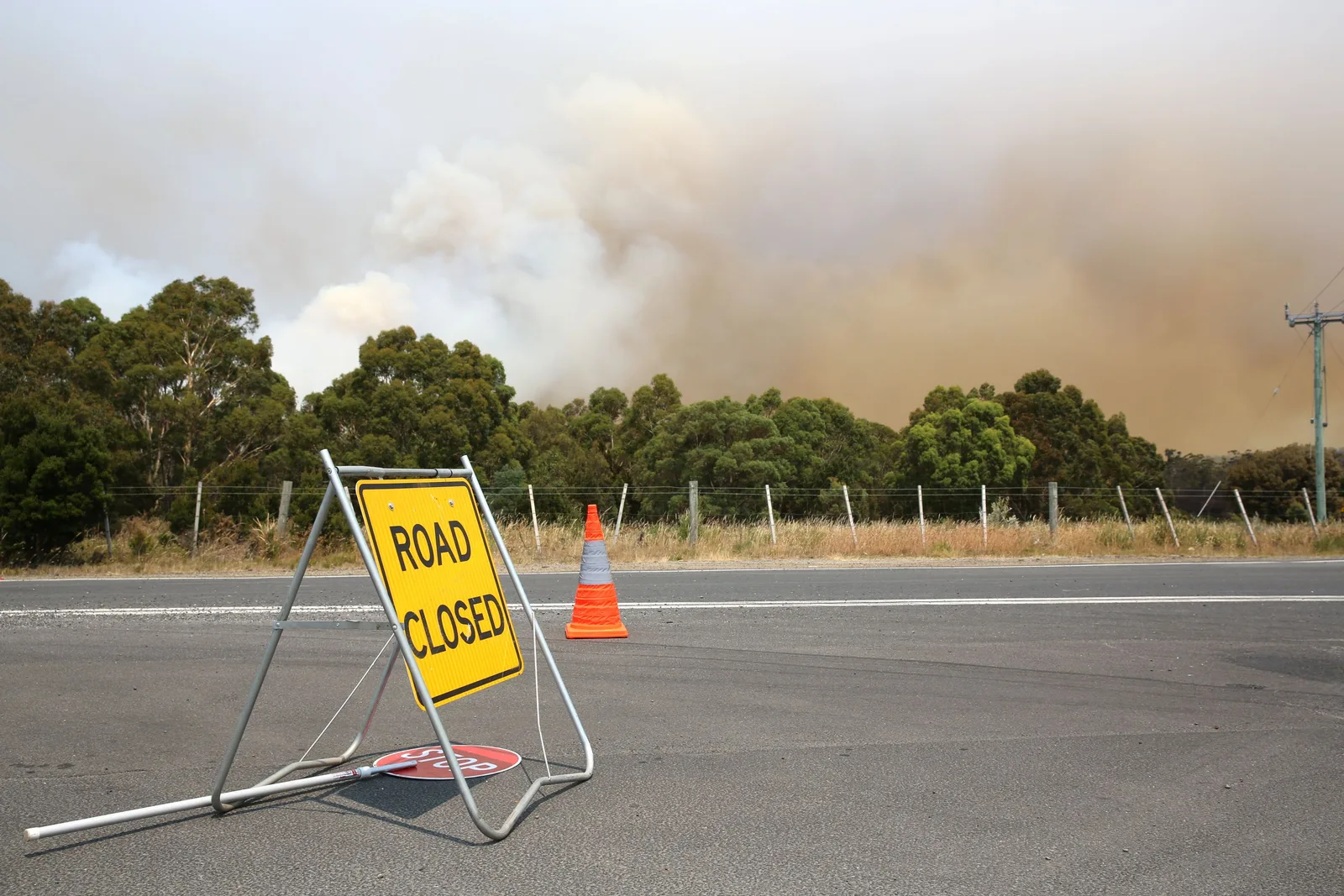
The fire is a hundred kilometres away and the trip is over anyway. Smoke and closures travel much further than flame.
The insurance and booking position
Standard travel insurance is a poor fit here, and this is the part most travellers get wrong. Cancellation cover pays on a defined list of causes; "the region is smoky" and "the trail is closed" are usually not on it. If an official advisory is issued against travel to an area, some policies cover cancellation and others void cover for travelling there anyway - read which, because the two outcomes are opposite and both are common.
Accommodation refunds depend on whether the property itself is affected or ordered to evacuate, not on whether the holiday has been ruined. A hotel forty kilometres downwind is open, operating and under no obligation to release you.
The practical mitigations are therefore booking flexibility rather than insurance: refundable accommodation in fire-season regions, an itinerary that can move to a different part of the country, and no large non-refundable commitment to a single valley in the peak weeks. Where an operator offers a weather-and-conditions rebooking policy, that is worth more than an insurance rider.
If you are in a region during the season
Register with the local emergency alert system on arrival. Most fire-prone jurisdictions have one, they are free, they usually work by SMS or a national app, and they are the only source that will reach you in time. Know two ways out of any valley you sleep in - and know which one climbs, because fire runs faster uphill and that is the exit you may not be able to use. Keep the vehicle above half a tank, because a fuel station without power cannot pump.
Follow evacuation orders immediately and without negotiating. The window between an order and a closed or blocked road is frequently short, and the people who die in these events are disproportionately those who left late or went back for something. Do not drive toward a fire to look at it: sightseers obstructing access roads is a documented, serious and recurring problem for the people fighting it.
And observe the fire restrictions absolutely - no open flame, no stove where stoves are banned, no cigarette, no barbecue, no vehicle parked on dry grass with a hot exhaust, no angle grinder, no drone anywhere near an incident. A large share of ignitions in inhabited regions are human, and a meaningful fraction of those are visitors who did not think a rule applied to a small fire in a still evening.
Sources
- The national emergency alert service of the destination
Register on arrival; it is the only source that reaches you in time. Fire-danger ratings and restriction levels are published daily in season.
- Official air-quality indices
Smoke forecasts and AQI readings are published by national environment agencies and are the input for the health decisions in this piece.