Journal
Reports, analyses and features from all 194 countries - the journalism behind the journeys.
The Fortress on the Hill
The first English colony in the Caribbean, the mother colony from which the rest were settled, and the last place in the eastern Caribbean to keep a sugar industry running - until 2005. Plus a federation with a secession clause its smaller half very nearly used in 1998.
Nutmeg, Revolution and an Invasion
The only country with a spice on its flag, once second only to Indonesia in nutmeg, until a hurricane destroyed ninety per cent of the trees in a night. Also the only English-speaking Caribbean state to have had a socialist revolution - and to have been invaded four years later.
The Island That Was Evacuated
Hurricane Irma flattened Barbuda in 2017 and the island was evacuated completely - for the first time in roughly three hundred years, nobody lived there. Months later, with residents still displaced, the law that had held Barbudan land communally since emancipation was amended to permit freehold sale.
The Banana Wars
Two of the largest economies on earth spent twenty years litigating at the WTO over the shelf price of fruit. The countries that lost were Windward islands with populations smaller than a European suburb, whose rural economies had been built on a European trade preference that the rulings removed.
The Island That Grew Back
Hurricane Maria crossed Dominica in three hours in 2017 and stripped every leaf from every tree on the island. Two months later its prime minister told the UN the country intended to become the world’s first climate-resilient nation. What that has actually meant, on an island with nine volcanoes and no beaches.
The Island That Wrote the Rules
Barbados industrialised the Atlantic plantation in the 1640s and drafted the legal code that governed it in 1661 - a template adopted almost verbatim in Jamaica, Antigua and South Carolina. In 2021 it removed the British monarch as head of state, and it now argues climate finance at the IMF with a voice its size does not predict.
Seven Hundred Islands and a Bank
Piracy, wrecking, blockade running, rum running, offshore banking, tourism: six industries, one location, five hundred years. An archipelago of limestone with no fresh water and no minerals has spent its whole history monetising its position - and is now among the countries most exposed to sea-level rise on earth.
The Republic That Paid for Its Freedom
In 1804 the enslaved population of a French colony defeated Napoleon’s army and founded the first Black republic in the world. In 1825 France sent a fleet and demanded compensation for the loss of its property - the people themselves - and Haiti paid, at interest, for over a century. This is not a guide; it is an explanation.
Small Island, Long Reach
Ska, rocksteady, reggae, dub, dancehall - and, through the sound systems Jamaicans carried to the Bronx and London, a substantial share of the DNA of hip hop and everything electronic that followed. An island of under three million invented the remix because it could not afford to hire a band.
The Island That Invented an Instrument
The steelpan is the only acoustic musical instrument invented in the twentieth century. It was invented in Trinidad, out of oil drums, by people the colonial authorities had banned from drumming and then banned from playing bamboo. What that says about carnival, calypso and the country is most of the story.
Two Countries, One Island
Hispaniola is the only Caribbean island split between two states, and the border is one of the sharpest economic gradients in the world. The oldest colonial city in the Americas, the massacre of 1937, a contested citizenship ruling - and a country most of whose visitors never leave the resort strip.
The Smallest Country and the Longest Wave
A world-class right-hand point break thirty minutes from an international airport, unknown for forty years because of a war. El Salvador’s recent history has been extreme in every direction - twelve years of civil war, two decades of the highest homicide rates on earth, and a state of exception that changed daily life and is still running.
The Reef That Was Taken Off the List
In 2009 UNESCO put the Belize Barrier Reef on the danger list. In 2018 it came off - after a country of under half a million people legislated an indefinite moratorium on its own offshore oil. What that saved the reef from, and what it did not.
The Canal That Never Came
Nature had already built most of a transoceanic canal across Nicaragua, and for two centuries the country was told it was about to be transformed by one. A volcano on a postage stamp sent the Americans to Panama; the 2013 Chinese concession broke ground and then evaporated. Nothing was ever built.
Two Currencies, One Island
For nearly thirty years Cuba ran two currencies and two parallel economies, which put surgeons behind the wheel of taxis. The unification of 2021 removed the duality and arrived alongside shortages, blackouts and the largest emigration in modern Cuban history. A portrait that holds both sets of facts at once.
The Islands That Rewrote Biology
A hotspot archipelago where the islands get older from west to east, three ocean currents collide, and nothing on land ever learned to fear a human. What Darwin actually noticed, what two centuries of whalers and goats destroyed, and what thirty years of eradication programmes have rebuilt.
Whale Season on the Quiet Coast
No roads reach Nuquí. Ten metres of rain fall every year. And each July, thousands of humpbacks arrive from Antarctica to calve in the warm Pacific bays - watched from wooden boats by one of the least-visited coastlines in the Americas.
The Lofoten Letters: Winter Above the Arctic Circle
At 68° north the sun does not clear the mountains for a month, and the four hours of colour that replace it are why photographers come. Winter in an archipelago that should be frozen and is not.
Finding Silence in the Noto Peninsula After the Quake
A magnitude 7.6 earthquake hit the Noto Peninsula on New Year's Day 2024, lifting the coastline by four metres and burning a market that had run for a thousand years. Whether to visit now has a specific answer.
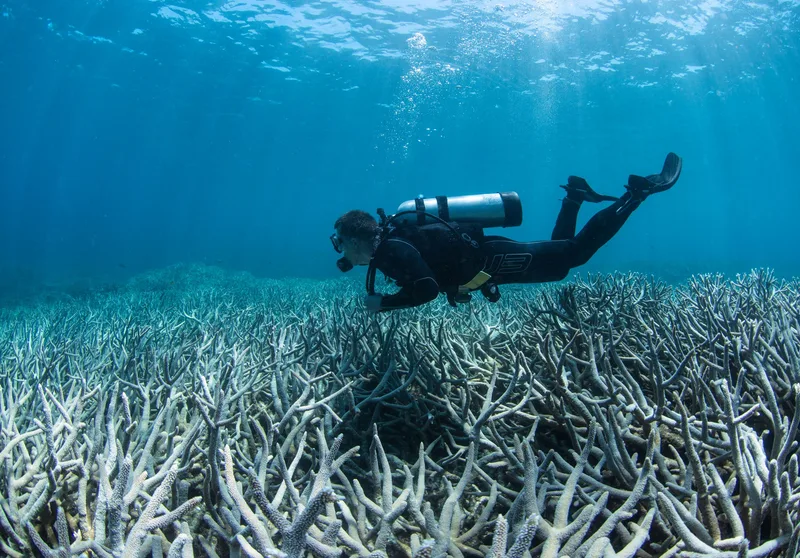
Starving, Not Dead
A bleached reef is a starving animal, not a dead one, and whether it recovers is decided by the next hot season. What that means for where diving is still worth the airfare - current, depth and enforcement, in that order.